Celebrating Women in Business and Conservation

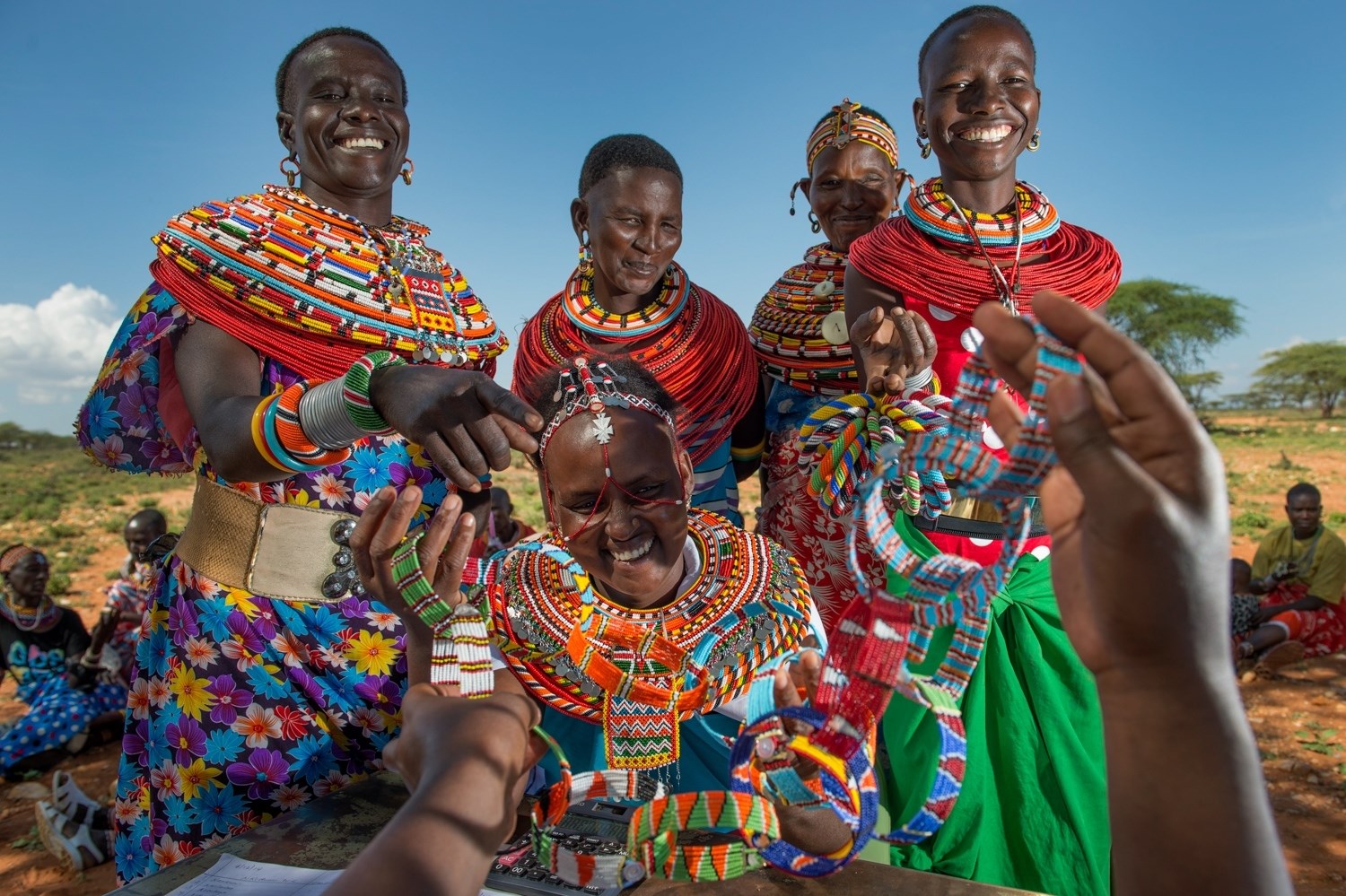
Picture this: A woman sits under the shade of an acacia tree, her hands working magic with tiny glass beads, threading them together to create patterns for a keychain that mirror the spots on a giraffe or the tusk of an elephant. At the end of the week, these ‘love letters’ to the wildlife and culture that inspires her craft will turn into an income.

This is the world of BeadWORKS, where something as simple as a glass bead becomes a lifeline, a voice, a force for change, and an unlikely product financing conservation efforts and developments in northern Kenya.

On 22nd July, at the Kalama Conservancy Headquarters, BeadWORKS artisans from nine NRT community conservancies across Isiolo, Samburu, Laikipia, and Marsabit came together for a noble cause, contributing KSh 3.5 million in conservation fees.

The funds were allocated as follows:

ConservancyConservation Fees (in KES)
Melako897,212
Il Ngwesi874,560
Sera394,304
Westgate370,204
Lekurruki268,863
Leparua242,948
Kalama230,772
Naibunga Lower136,270
Naibunga Central132,208

This amount represents 5% of their annual sales income, dedicated to supporting conservation efforts and community development projects, like supporting conservancy rangers, wildlife protection, or school bursaries. Since its inception in 2016, the conservation fee model under BeadWORKS has generated KSh 13.37 million, directly benefiting community-led conservancies.

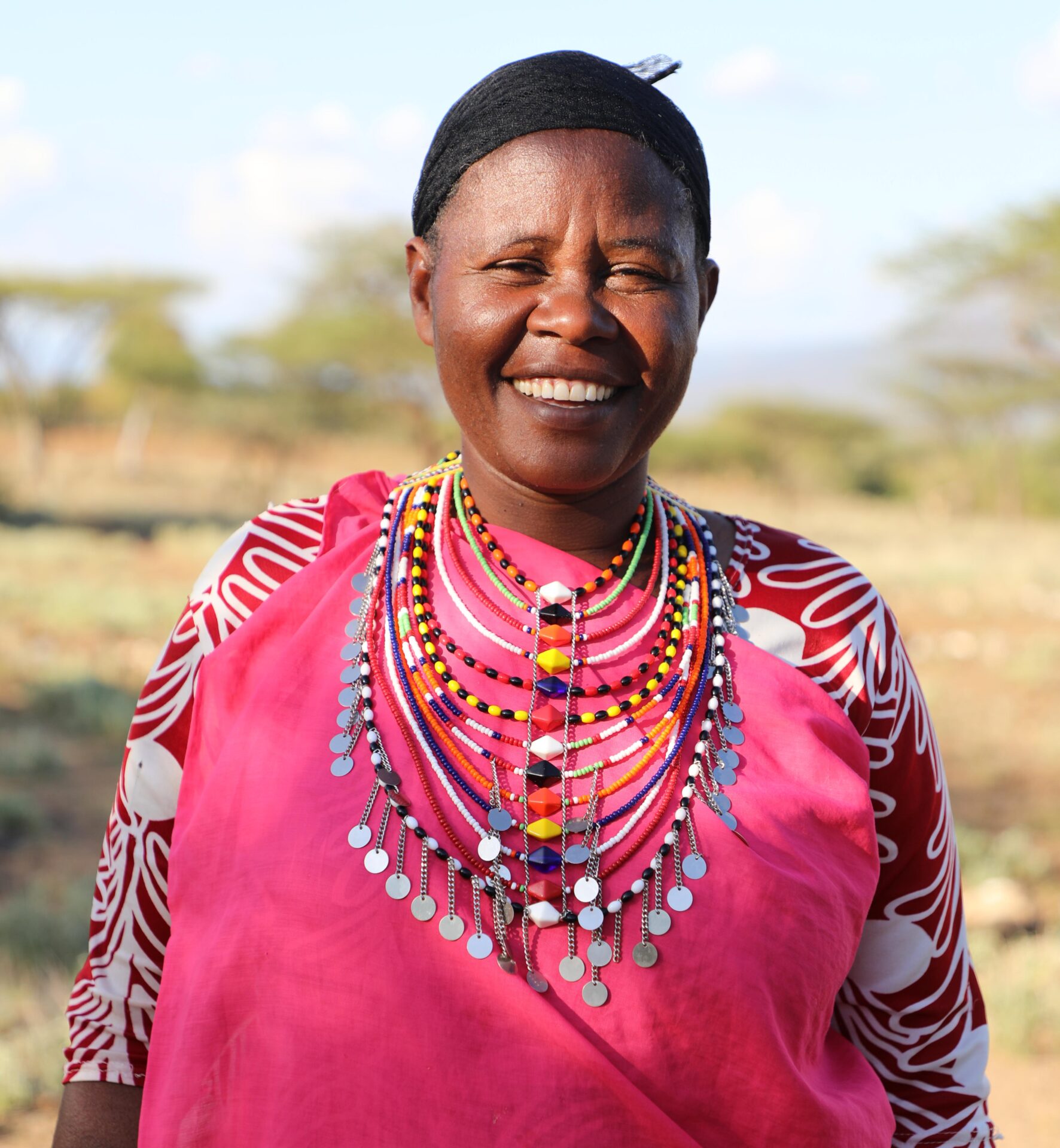
BeadWORKS, a World Fair Trade Organization-certified enterprise, is a business line under MashinaniWORKS that has, for over 15 years, established an organized network of 1,200 pastoralist women in northern Kenya, creating income-generating opportunities by transforming their traditional beading skills into high-quality, handcrafted products.

In 2024 alone, BeadWORKS generated Ksh 36.2 million in product sales, raising its total revenue since 2016 to Ksh 267.45 million. The women themselves earned 10.6 million shillings in 2024 from creating 75,626 products – earrings, belts, keychains, decorative pieces, and more. Over the years, these artisans have put 80 million shillings directly into their own pockets – money that allows them to pay school fees, put food on the table, start businesses, and, in several cases, leave behind destructive survival activities like charcoal burning.

“BeadWORKS is not just about beading. Every bead tells a story – of resilience and economic empowerment of our women. It’s a skill that takes them from one level to another.” Salma Lekoomet, BeadWORKS Production Manager.

In the communities where BeadWORKS operates, women traditionally haven’t had much say in decision-making, but that has since shifted.

The women have gone on to take leadership roles among themselves, serving as Star Beaders or members of peace committees, and even in conservancy boards. Now, when meetings happen, women’s voices fill the room. When families make financial decisions, women contribute to the discussion. When children dream about their future, they see their mothers as examples of what’s possible.

They have also gained access to financial institutions, like the Rangelands SACCO, where most of them are members, allowing them to save money and take loans.

“Previously, many of us relied on our husbands for financial support, always waiting for them to provide for our needs. However, now that we’ve achieved financial independence, the dynamics have shifted, allowing us to contribute equally and support one another.” Joyce Lelukai said, adding that, “I also opened an account with Rangelands SACCO, and I’ve borrowed loans for starting my businesses and building a modern house.”

She was echoed by her counterpart, Nkasupat Leariyaro, who is a Star Beader and vice chairperson of the Melako Conservancy board. Through BeadWORKS, Nkasupat has been exposed to life-changing experiences, including the recent trip to the United States of America.

At the celebration officiated by the Marsabit Deputy Governor, Hon. Solomon Gubo, along with other county officials and partners, 103 Star Beaders were recognized and awarded Ksh. 1.17 million. The artisans work in groups, with each Star Beader supervising between 10 and 15 women. They play a crucial role in ensuring quality control and coordination, serving as the link between their network and the BeadWORKS office. They also provide mentorship and training to their members.

That didn’t stop there. Nine Star Beaders from each conservancy were awarded for their outstanding performance. Three best overall beaders out of the 1,200 – Nasaru Leariyaro of Melako Conservancy, Christine Shuel of Il Ngwesi Conservancy, and Nantiyon Letaapoof Sera Conservancy – were awarded with solar kits.

Melako and Il Ngwesi Conservancies also won Best Conservancies in the year 2023/24 awards.

Melako Conservancies members celebrate after being awarded a trophy for the Best Overall Conservancy 2023/24. ©MashinaniWORKS

What started in the villages of northern Kenya now reaches across oceans. BeadWORKS handcrafted products appear in displays across Africa, North America, Australia, and Europe. Every purchase connects someone thousands of miles away to these talented artisans.

Here, the BeadWORKS e-commerce website has been a transformative success. The website generated Ksh. 827,148 in sales in 2024 alone, but more importantly, it has been winning recognition. The Kenya E-commerce Awards have consecutively honored BeadWORKS: Gold for Best Sustainability Initiative in 2022, Gold for Best International/Export E-commerce website in 2023, and in 2024, a triple win – Gold for Best Handcrafted Fashion E-commerce Website, Silver for Best Cross-Border E-commerce Website, and Silver for Best Jewelry E-commerce Website.

BeadWORKS has also established itself as a globally recognized brand, partnering with other brands such as Ibu Movement, the Ethical Fashion Initiative, and Mifuko – all of which share similar perspectives to BeadWORKS.

This network of women has grown into something unprecedented in northern Kenya’s Arid and Semi-Arid Lands (ASALs) – a women-led enterprise addressing profound challenges including gender-based violence, poverty, malnutrition, and insecurity, through economic empowerment.

Across nine conservancies, the 1,200 women will continue the work that has already proved to be life-changing.

When you choose BeadWORKS, you’re carrying the dreams of women who wake up every morning and choose to make their world better. You’re making a business transaction with some of the most skilled artisans in Africa. You’re ensuring that their children stay in school, you’re connecting your style to their story, and your purchase to their power.

Visit www.beadworkskenya.com to purchase beautifully beaded handcrafted products made in northern Kenya that change lives.


Gallery

A 19-Year-Old Turning Her Passion Into a Paycheck

Born and raised in Kiwanja, within the Maiyanat Conservancy in Laikipia County, Jackline Wamoke was practically raised on the scent of hair oils, the rhythmic tug of braids being parted and plaited, and the lively chatter that fills a salon.

Her mother, a long-practicing hairdresser, passed down more than a profession; she nurtured a sense of possibility. Jackline’s older sister followed that same path, and together, they formed a kind of informal apprenticeship that shaped Jackline from an early age.

During school holidays, she would spend hours in the salon, slowly learning the techniques through observation and practice, the rhythm of customer care, and the business instinct required. These small acts of care and craft shaped Jackline’s childhood and, over time, revealed that she could one day take on the family trade.

After completing Form Four in 2023, she enrolled in Ujuzi Manyattani in March 2024, a program designed to empower young people in marginalized areas by offering hands-on vocational skills locally relevant to their communities’ needs, which can translate into immediate income. The training went far beyond what she had learned in her mother’s salon. Ujuzi Manyattani introduced her to contemporary trends in beauty and personal care, expanding her expertise to include beauty therapy, such as makeup, manicures, and pedicures. Jackline quickly distinguished herself among the top performers in her cohort, propelled by a desire to elevate her craft to a professional level.

Upon graduating, Jackline wasn’t looking for a job; she was returning to one. Her sister, who had been managing the family salon, passed the baton to Jackline and was ready for its next phase. She made immediate upgrades to the salon, starting with the tools she received through the Ujuzi Manyattani program to redefine the customer experience. She replaced the small wall-mounted mirror with a full-sized one, added a blow dryer and a sink for improved hair treatment services, and hair clippers to begin offering barbering, an in-demand service in the area.

These changes might seem small, but they made a world of difference in both the quality of service she could provide and how customers viewed her business. She didn’t need to win the community’s trust from scratch. They already knew her first as the young girl helping around the salon, later as a trained stylist with new skills to offer. In Kiwanja, where only two other salons operate, competition is limited, and Jackline’s reputation gives her a natural edge. She’s precise, whether it’s lines for schoolgirls, plaits for weekend weddings, or a fresh shave for the boys, she does it all with passion, making sitting on her salon chair something to look forward to.

On a regular day, she sees four to five customers, though that number often rises during peak periods, such as school openings and community events. Her mother, still very much part of this evolving journey, often steps in to help during these high-traffic days. On a good day, Jackline can make anywhere from Ksh. 800 to Ksh. 3,000, depending on the number of customers she serves.

Now, her income is directed to savings, but she still manages to set something aside for her younger siblings’ pocket money and help out with the little things that add up in a household, such as restocking sugar when it runs out or picking up flour on her way home. Her entrepreneurial spirit also pushed her to start selling shoes, clothes, and beads from her salon, which is another way to earn extra money.

Jackline dreams of expanding her salon into a larger space to accommodate more customers and offer additional services.

Thanks to the funding support from Fauna and Flora, under the Darwin Initiative through the Northern Rangelands Trust (NRT).

Rangelands SACCO: Harnessing Inclusion for Economic Development

At the age of 10, Alice Shakinei from Masol Community Conservancy in West Pokot County experienced a severe reaction in her right leg following a polio injection during a clinic visit.

Her family sought treatment from community herbalists, and after several failed attempts, took her back to the hospital. Unfortunately for Alice, it was too late. She was left with a disability that physically restricted her in multiple ways. Determined to rise above her circumstances, Alice grew up to become an industrious lady who today runs her own petroleum business.

On a typical day, you will find her cheerfully filling up her jerry-cans with petroleum, ready to serve her customers. Before she established her business, Alice was a stay-at-home mother with no source of income, and was left to raise her children by herself after her husband left.

“At that moment, I knew that the children were looking up to me as their provider, so I decided to start selling petrol and diesel on people’s verandas. It took me two years before I secured a space.”

In 2019, Alice used a Ksh 25,000 loan from Rangelands SACCO to grow her business. As the sole fuel supplier in her area, which lacks a petrol station, the demand for her products and services has risen. On a good day, she makes up to Ksh 10,000 and on an average day, up to Ksh 6,000.

The business training Alice received from Biashara Mashinani played a crucial role in the expansion of her business. “I had the skills and a bit of knowledge, but what I was taught was not even close to half what I knew. Learning budgeting, proper business planning, record keeping, and time management helped me,” she explains.

Alice fills a jerry can at her shop in Marich Centre, West Pokot County. Photo|©MashinaniWORKS

Alice is not immune to the stigma associated with her condition. “People have said negative things about me, but at the end of the day, I know that I am the only one who can help my children and myself.” Additionally, Alice’s limited mobility causes her to lose customers sometimes, as deliveries are unsuccessful or delayed.

These challenges would discourage many, but not Alice, now 37. She draws strength from knowing she has built a safe home for her three children and ensured they have access to education and other basic necessities. Alice aspires to own a petrol station and serve customers from all parts of the country. Her advice to young girls and women is, “Prioritise venturing into business, embrace everything that comes with it, and do not let anything stop you from achieving your goals.”

Beads of Hope: How BeadWORKS is Transforming Lives of Pastoralist Women through Handicraft

Isn’t it amazing when mastering a craft becomes a pathway to financial independence and community leadership? For Nampaiyo Lepartingat, this was her reality.

As a mother of seven from Kalama Community Conservancy, Samburu County, her daily life revolved around caring for her family and managing their livestock. The unpredictability of livestock sales often left her financially strained, relying solely on her husband’s income. However, Nampaiyo sought ways to improve her family’s financial stability.

Everything changed five years ago when she discovered BeadWORKS through a friend. Intrigued by the prospect of earning additional income without leaving her home or livestock unattended, she eagerly embraced the opportunity to learn. Joining a Kalama women’s beading group, Nampaiyo quickly distinguished herself as a diligent and skilled artisan. Her talent in creating beautiful pieces and natural leadership capabilities rapidly became evident, leading to her recognition as a starbeader. She is one of 108 starbeaders and acts as a link between BeadWORKS and the beaders. Her responsibilities extend to serving as a supervisor and providing support, guidance, and leadership to the group members.

Through BeadWORKS’ support and training initiatives, Nampaiyo honed her beading skills and gained an understanding of financial management and entrepreneurship. The training offered through the Rangelands SACCO equipped her with essential knowledge in savings and credit management. This enabled her to invest in her businesses, including setting up a successful chicken-rearing business and a shop with mobile money services. With her earnings, Nampaiyo built a modern home for her family, replacing their traditional grass-thatched dwelling, and also provided her children with better living conditions, including access to electricity for smooth learning and security.

Since 2015, BeadWORKS has become a driving force for change among 1,200 pastoralist women in northern Kenya. By leveraging the inbuilt skills of these pastoralist women, BeadWORKS has effectively turned their artisanal craft into a sustainable source of income. For Nampaiyo and the other women, market linkages have been created locally and internationally, expanding their economic opportunities. This increased market access has amplified the impact of BeadWORKS, leading to further economic growth and empowerment for the women.

From Hotel To Shop To Transport Businesses – Mikelina Leparmorijo’s Entrepreneurial Journey

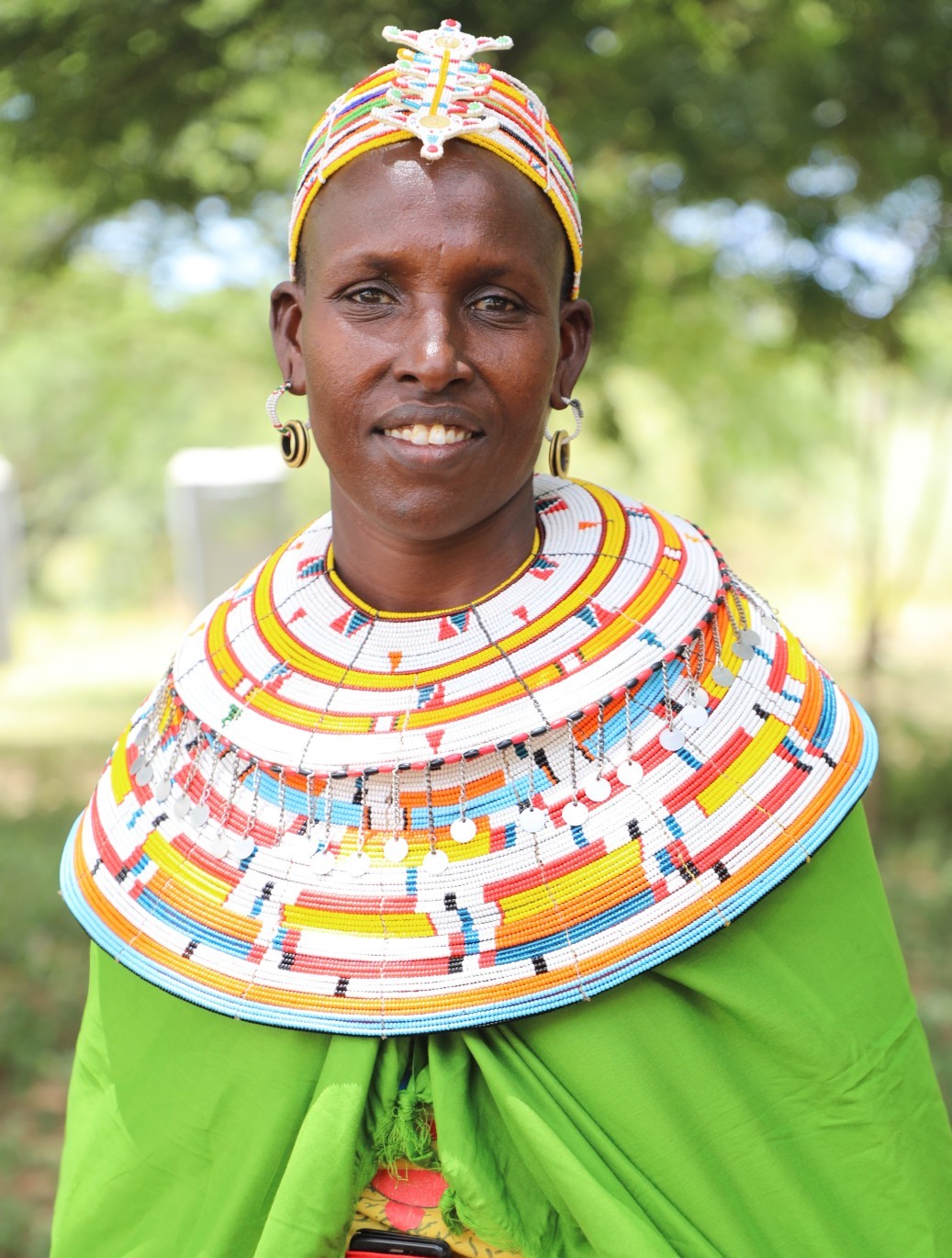
Mikelina Leparmorijo is a 50-year-old mother of 7 who was born into a pastoralist community. She grew up surrounded by traditional livestock-keeping, the primary income source for her family and many others in the community. However, at the young age of 15, Mikelina was forced into marriage and didn’t have the opportunity to continue her education beyond Class 8.

Despite this setback, Mikelina’s entrepreneurial spirit never wavered. A few years later, she began running a hotel and preparing meals for locals, which allowed her to earn enough money to support her children. However, she knew that she needed to diversify her income stream to ensure financial stability for her family.

In 2016, Mikelina learned about the Rangelands SACCO through the Conservancy management and immediately joined as one of the 300 members. Together with other women, she received her first loan of KES 25,000, which helped her boost her hotel business. Michelina later became a Conservancy Enterprise Agent to help recruit new members and follow up on outstanding loans.

“Rangelands SACCO came to our remote areas to change our lives. They trained us to earn a diversified income without depending on livestock. We know about saving and budgeting, and our businesses are running smoothly. We have averted the loss of livestock during the drought period because we were taught how to manage that.” Mikelina happily says.

With the help of the SACCO, Mikelina was able to take a development loan of KES 100,000, which she opened a shop to diversify her income in addition to investing in a vehicle that is being used for transport business together with her sons. Her hard work and dedication paid off when she was elected as the SACCO Chairlady two years ago, a position she holds with pride. Mikelina is proud that more women from her community are taking the opportunity to save and borrow loans from financial institutions like the Rangelands SACCO to improve their lives. Before, they depended on their husbands for everything, but now they have stable businesses.

Today, Mikelina celebrates the increasing number of women in her community who, like her, have embraced the power of savings, loans, and diversified businesses. These women have achieved financial independence, established stable businesses resilient to natural calamities, and secured brighter futures for their children through better education and improved living conditions.

Leadership in Business and Conservation – The Story of Pauline Lolngojine

Recently, women in northern Kenya have emerged as key decision-makers in their communities. They now hold leadership positions and have gained control over benefits, which has resulted in their full participation in the economy as market actors.

Pauline Nduraa Lolngojine is a 47-year-old mother of five from Archers Post in Samburu County, whose story embodies resilience, community impact, and empowerment. Married off at a young age, her education was abruptly cut short in Form 3. However, Pauline chose not to despair. Undeterred by the following hardships, she seized an opportunity during the construction of the Isiolo-Moyale highway to start preparing and hawking meals for the workers. This marked the beginning of her entrepreneurial venture, and she soon expanded to selling groceries by the roadside.

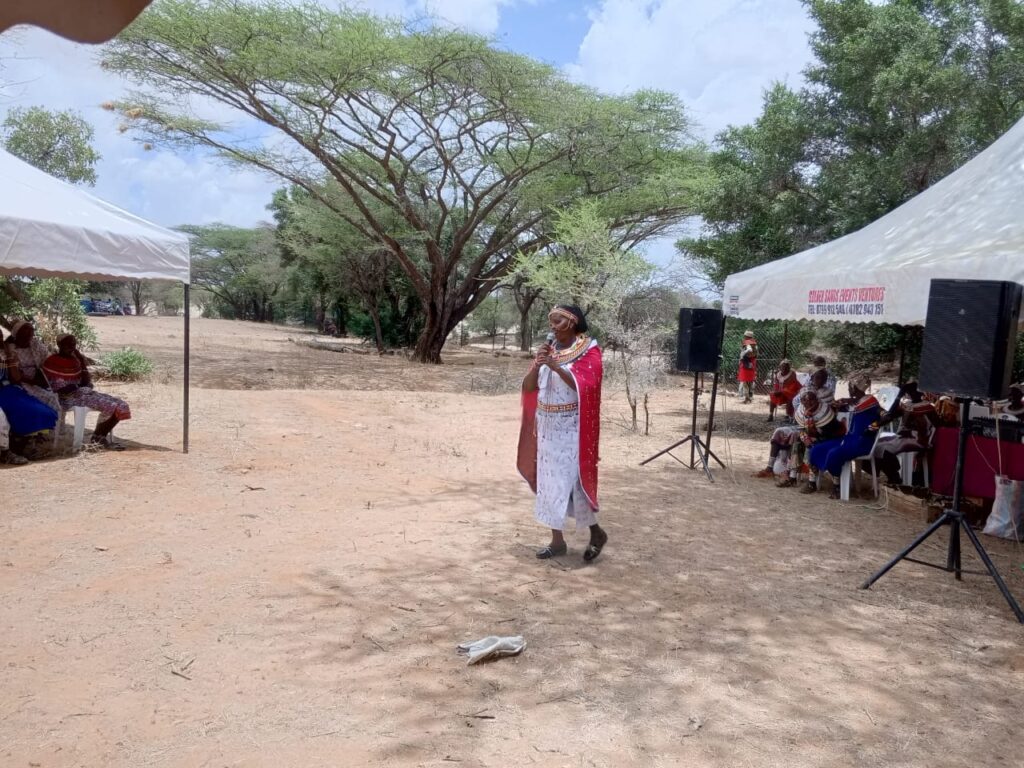
Pauline addresses women during the Marsabit women’s caucus.

As a member of the Sera Community Conservancy, Pauline’s conservation efforts earned her a position on the board, where she later became the tourism chairperson, breaking barriers as the only female in this role. Her journey continued as she was re-elected as the Conservancy’s Chairperson, solidifying her position as a powerful voice for women.

In 2018, Pauline joined Rangelands Savings and Credit Cooperative (Rangelands SACCO), an independent, community-owned, and membership-driven financial organization. Elected as the chairperson, she embraced the training and guidance provided by the SACCO to become a star entrepreneur. Through Rangelands SACCO, Pauline received loans that she strategically invested to catalyze the growth of her businesses. The entrepreneurial and financial literacy training, including business planning, customer service, marketing and branding, managing profits and losses, costing, and pricing, equipped her with the skills to manage every aspect of her enterprises.

Being among over 6,000 members, the impact of Rangelands SACCO on Pauline’s life is evident from an initial loan of KES 30,000 to her latest loan of KES 900,000. She secured her children’s education and a plot for her restaurant and invested in equipment and materials, elevating the quality of her services. The loans met her progressive targets and positioned her in a better place.

Pauline provides outside catering services at Uaso Girls to children on an educational trip.

Her entrepreneurial journey saw her venture into diverse fields, from groceries by the roadside to outside catering services and a Choma Zone (roast meat) restaurant that will serve travelers along Archers Post.

In the Annual Delegates Meetings held on 26th April 2023 and 7th March 2024, she was celebrated as the best borrower in 2022 and 2023, respectively. “The awards motivate me to keep achieving my goals in the Sacco and being a role model by uplifting others through giving them advice and showing them my best practices,” says Pauline. Her journey with Rangelands SACCO is not just about financial gains; it’s about inspiring and uplifting an entire community, creating a ripple effect of positive change. Pauline has become an employer, creating job opportunities and contributing to the economic growth of her community.

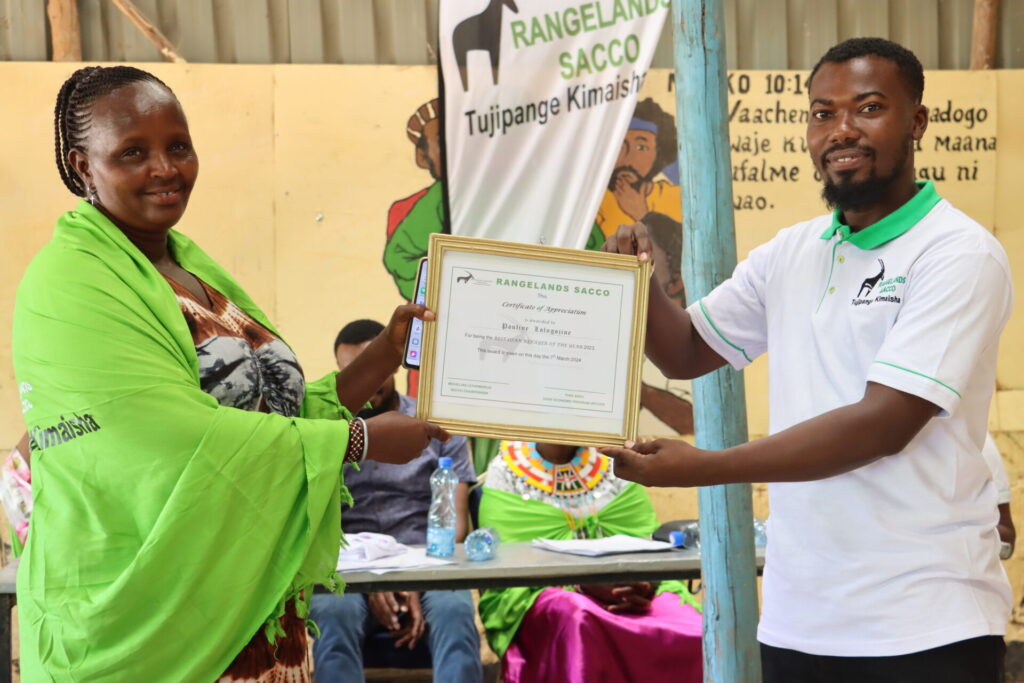
Pauline receives her certificate as the Best Borrower in 2023 during the Rangelands SACCO Annual Delegates Meeting held on 7th March 2024
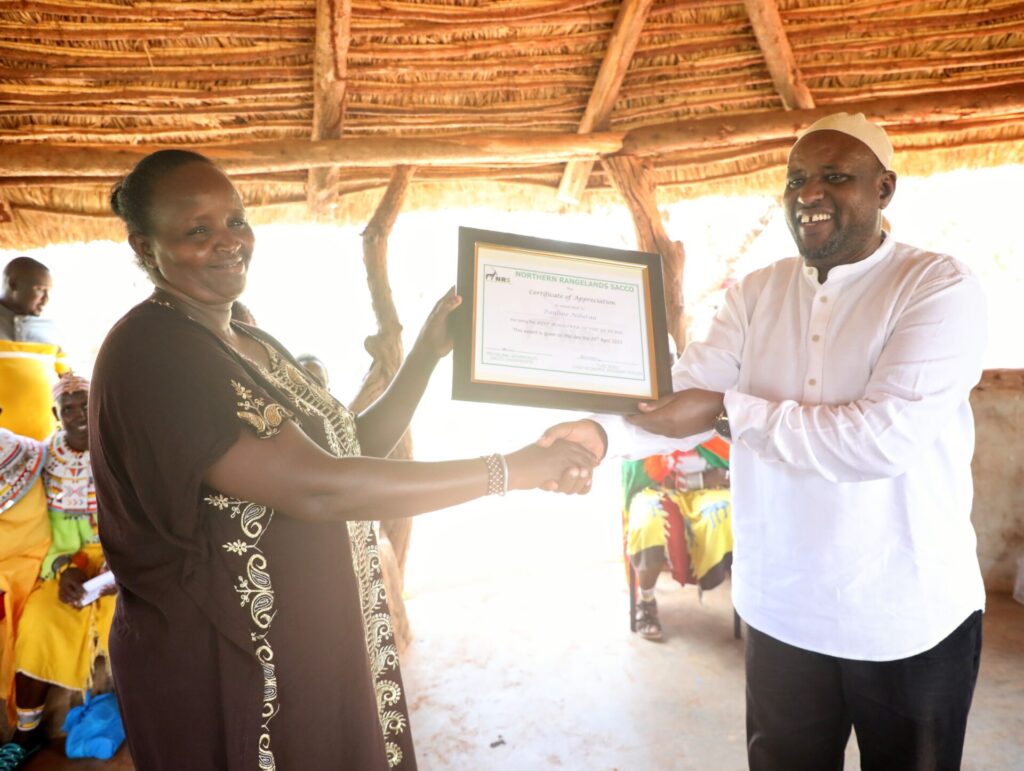
Pauline receives her certificate as the Best Borrower in 2022 during the Rangelands SACCO Annual Delegates Meeting held on 26th April 2023

As Pauline envisions securing plots for accommodation facilities and campsites, her dreams extend beyond personal success. She aims to contribute to the growth of the local economy and leave an indelible mark on the community that she holds dear.

Rising Beyond Terrorism Scars: Mumina’s Extraordinary Journey from Tragedy to Triumph

Insecurity has long plagued Kenya’s northern and coastal regions, casting a shadow over the dreams of its residents and inflicting pain upon countless families. Yet amidst this adversity, there emerges an inspiring story of a 21-year-old that encapsulates resilience, determination, and an unyielding spirit.

In 2017, a young girl named Mumina Omar, then in seventh grade, embarked on her usual journey from the Mararani villages to Kiunga Primary School in Lamu County. Little did she know that this ordinary commute in search of education would forever alter the course of her life.

Mumina and her fellow pupils were en route to school when tragedy struck along Mararani to Kiunga road. Their vehicle unwittingly triggered a landmine planted by a militia group, resulting in a deafening explosion and a fiery inferno. Mumina vividly recalls the horrifying moment, “the only thing I remember is a big loud explosion followed by fire.”

Trapped in the Boni forest, their remote location delayed rescue efforts until late into the night, leaving four of her fellow pupils dead. However, Mumina was not rescued then, for the impact of the explosion catapulted her far from her peers. She spent a harrowing night alone in the forest, consumed by pain and fear, eventually lapsing into unconsciousness.

It wasn’t until 11:00 a.m. the following day that Mumina was discovered during a renewed search mission prompted by her family’s frantic report of her disappearance and rushed to Agha Khan Hospital in Mombasa. After two weeks, her condition failed to improve, and she was subsequently transferred to Kijabe Mission Hospital in Nairobi. Tragically, the extent of her injuries necessitated the amputation of one of her legs three months later.

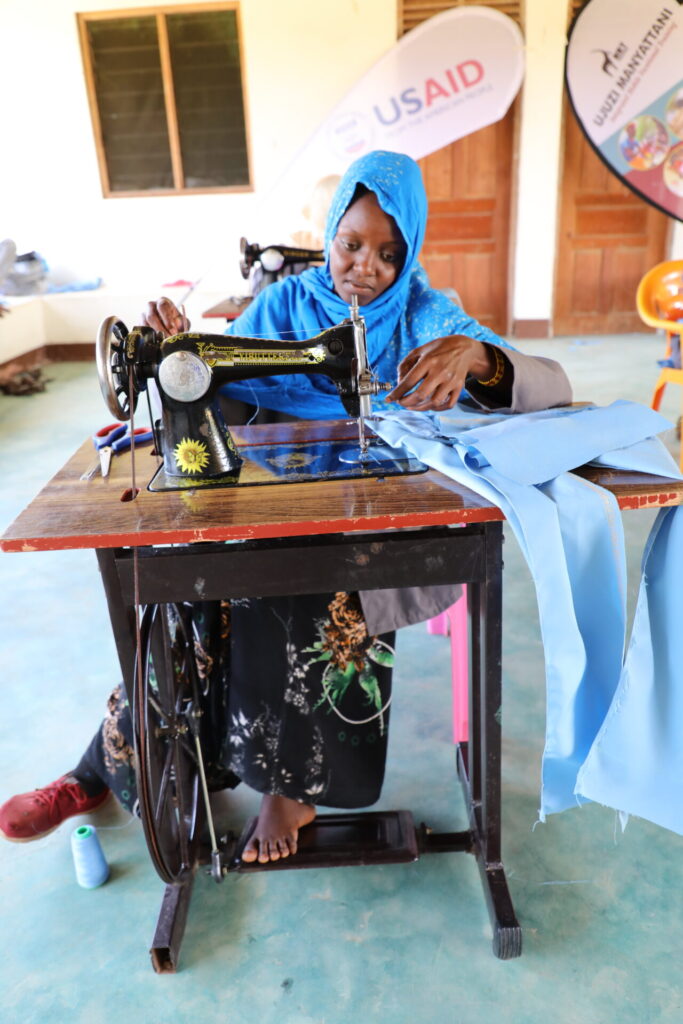
Mumina showcasing her tailoring skills during a National Industrial Training Authority (NITA) assessment.

The loss of her leg had profound repercussions, affecting not only her education, dreams, and self-esteem but also her family resources. Yet, Mumina’s indomitable spirit prevailed. With the help of an artificial leg supported by a good samaritan, she returned to school in 2019, persevering through bouts of excruciating pain to complete her education up to form four.

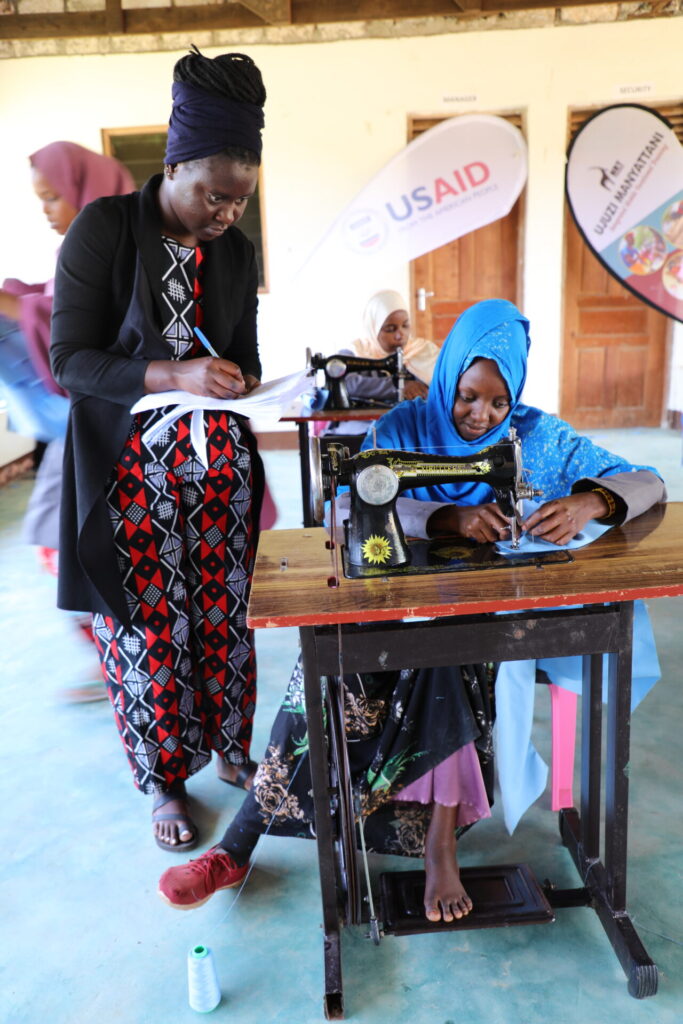
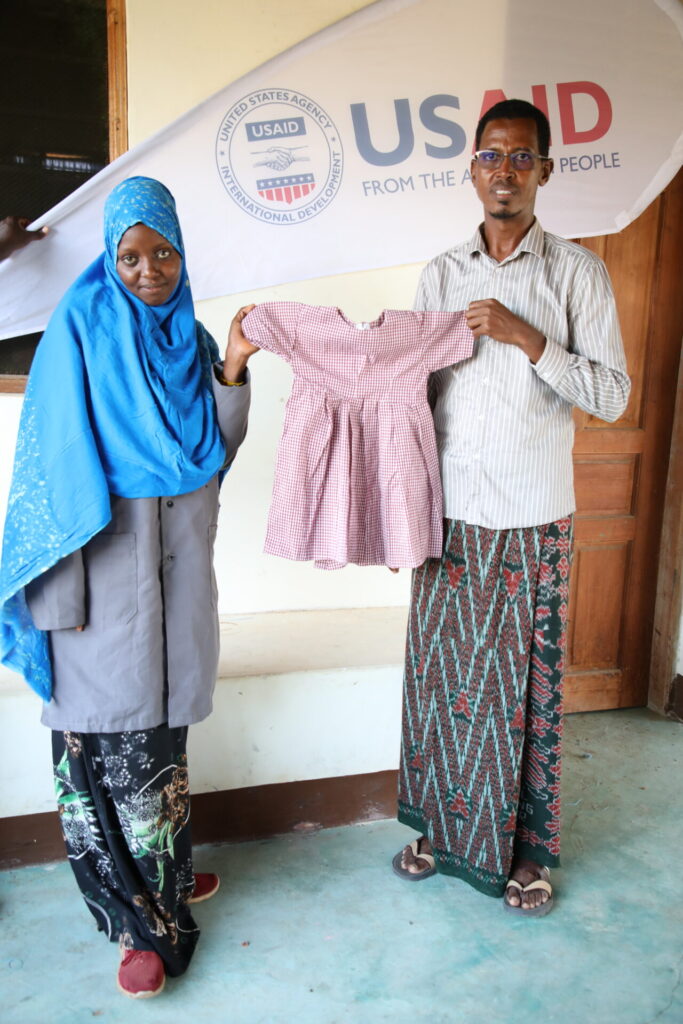
After completing her secondary education, her pains anchored her within the walls of their home, where she dutifully assisted her parents with minor tasks, her aspirations for a brighter future seemingly constrained by her condition. In a twist of fate, Mumina’s path crossed with Ujuzi Manyattani in 2023, a program dedicated to empowering young men and women in marginalized communities through the support of the USAID Local Works program. The NRT Trading Coast regional Ujuzi Manyattani Coordinator encouraged her to enroll in the program, and that’s when she embarked on a three-month training in tailoring & dressmaking course. Despite her fears and doubts, through sheer determination and the unwavering support of her parents, trainer, and fellow trainees, Mumina learned to sew a wide array of clothes.

Today, as you observe Mumina gracefully operating a sewing machine pedal, you might mistake her for any other trainee in the class. But her story sets her apart. She uses just one leg to master the art of tailoring. This remarkable feat was born out of necessity, a necessity that arose from a fateful day in 2017.

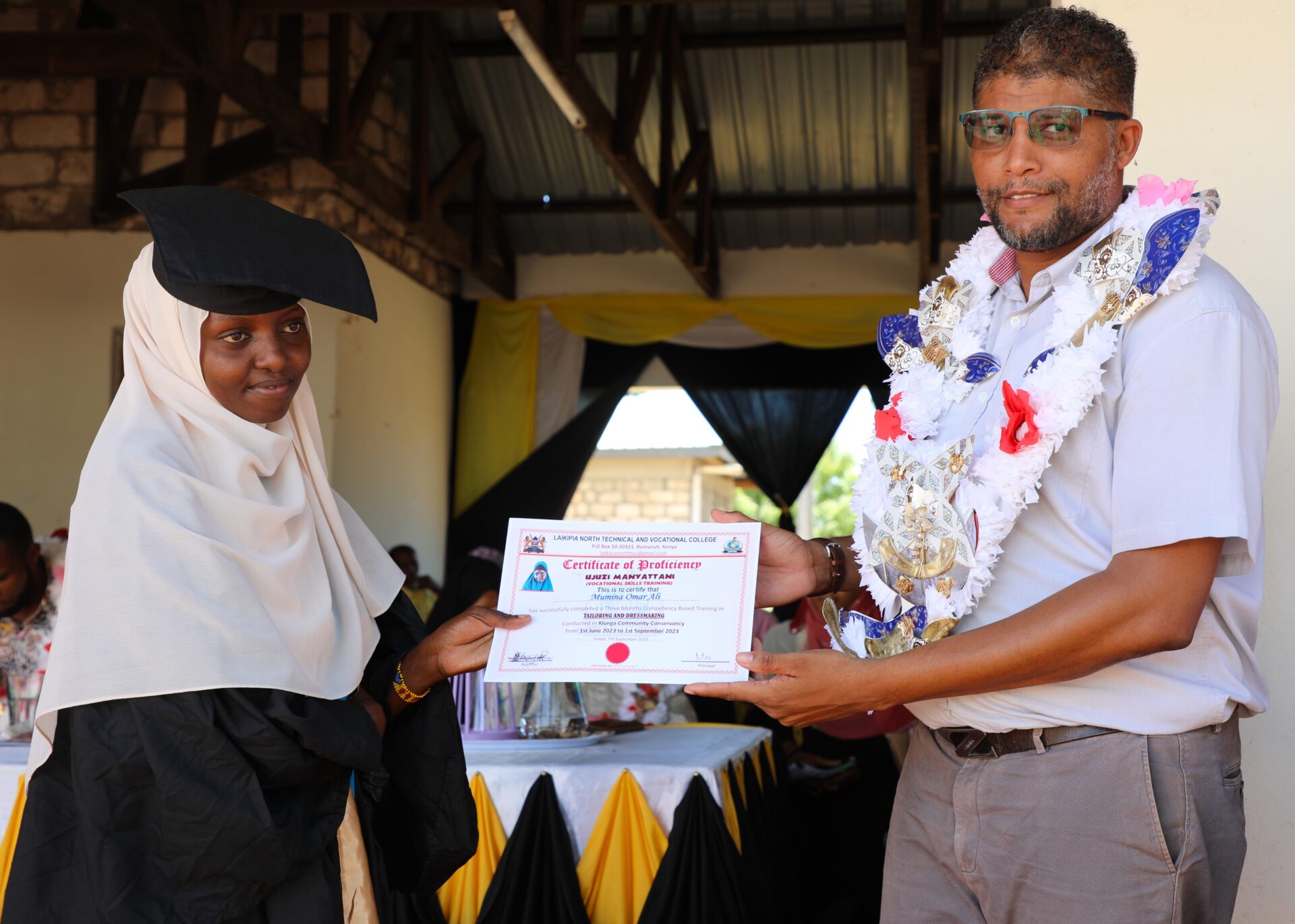
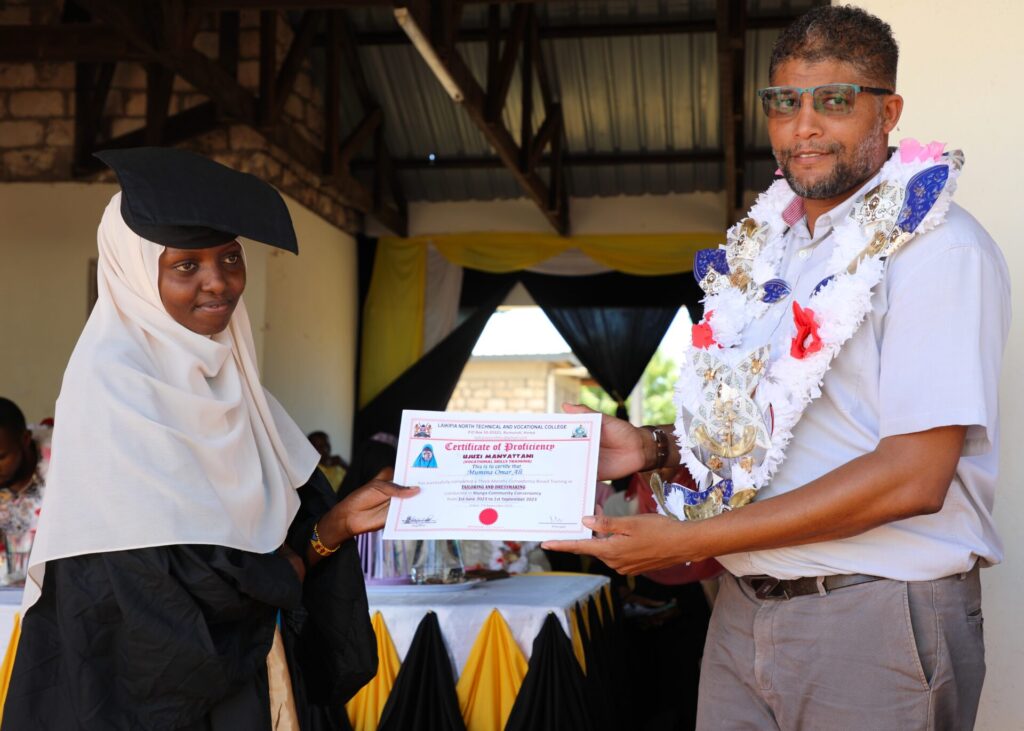
Behind Mumina’s radiant smile and confidence at the sewing machine lies a heartbreaking journey transformed by newfound life skills. She defiantly declares that the militia groups may have robbed her of one of her legs, but they never robbed her of her destiny. Today, we celebrate Mumina Omar as she graduates and is issued with the startup tool kits through the support of the USAID Local Works Program alongside the other 30 trainees from Kiunga Community Conservancy.

Mumina’s story embodies the human spirit’s ability to rise above even the most daunting challenges of terrorism. It serves as an inspiring reminder that determination can conquer adversity and dreams can endure despite the darkest of days. Ujuzi Manyattani is a beacon of hope that empowers individuals like Mumina by imparting a diverse range of vocational skills, from vessel repair, mobile phone repair, catering, masonry, electrical installation to hairdressing and beauty therapy, and motorbike repair and maintenance in eight Counties of northern and Coastal Kenya.  
Mumina receiving her certificate during the Ujuzi Manyattani graduation held on 31/10/2023 in Kiunga Community Conservancy, Lamu County in Kenya.
To date, 1,102 young women and men have graduated with vocational skills training and have been issued startup tool kits to help them earn an income and secure their livelihoods. The graduates of Ujuzi Manyattani inject over KES 60 million annually into the local economy through income earned, as per an impact survey conducted in January 2023. The survey further reveals that at least 88% of our graduates embarked on self-employment through setting up their businesses.

Breaking Tradition: Mary Leleruk’s Poultry Revolution

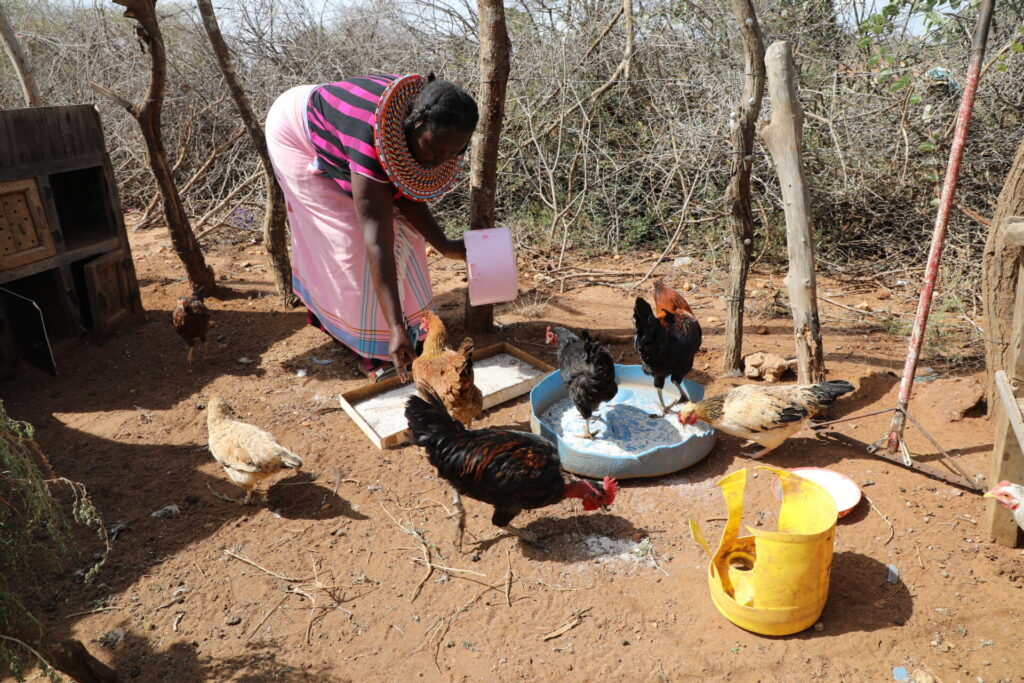
Mary Leleruk is a Maasai woman who lives in the heart of Naibunga Lower Community Conservancy in Laikipia County. She has been practicing beading for many years and has been training others in the art as well. In Maasai culture, beading has always been integral to women’s daily life. However, chicken rearing was traditionally considered an enterprise of low value compared to larger stock such as cattle and was thus overlooked. Mary, too, did not prioritize it in her homestead.

However, a transformative opportunity emerged in 2021 through the support of USAID Local Works and the Ufugaji Bora Mashinani program recognized the potential of poultry production training targeting sixty women and youth.  This aimed to introduce poultry training to change their perception towards chickens and to provide them with skills and opportunities to increase their household income. Additionally, it aimed to diversify livestock value chains.

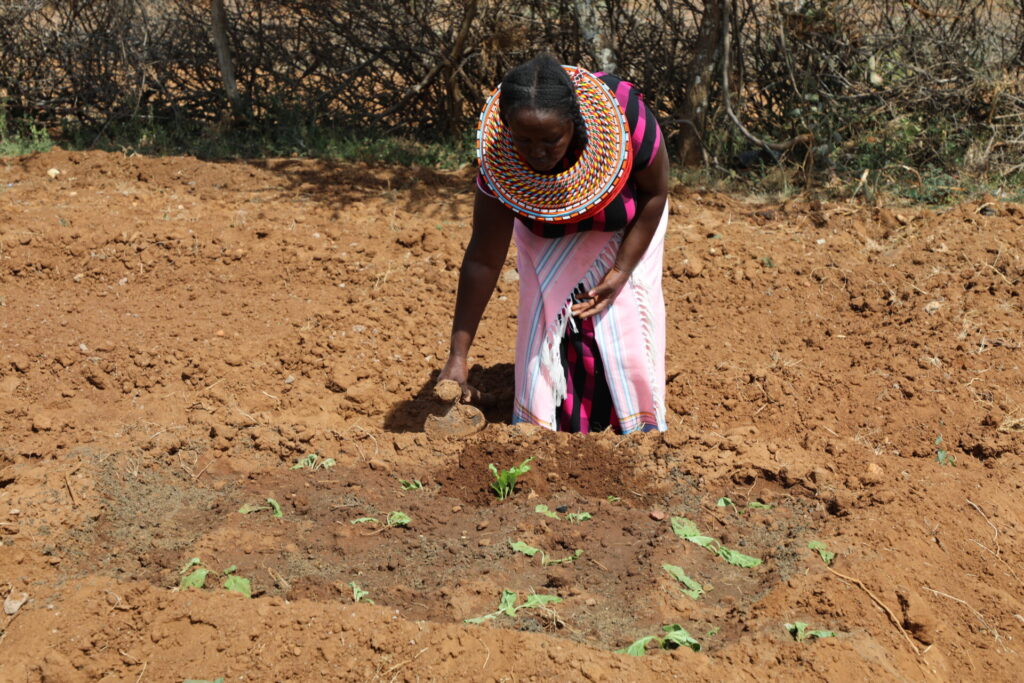
Mary planting kales (sukumawiki) in her garden using poultry manure.

Selected among sixty women through the Ufugaji Bora Mashinani program, Mary delved into intensive training. This changed her perception of poultry rearing. She absorbed knowledge on building poultry houses, safeguarding against diseases, and crafting nutritious feeds from local resources. Maggots, rich in protein, became a staple ingredient sourced from cow dung.

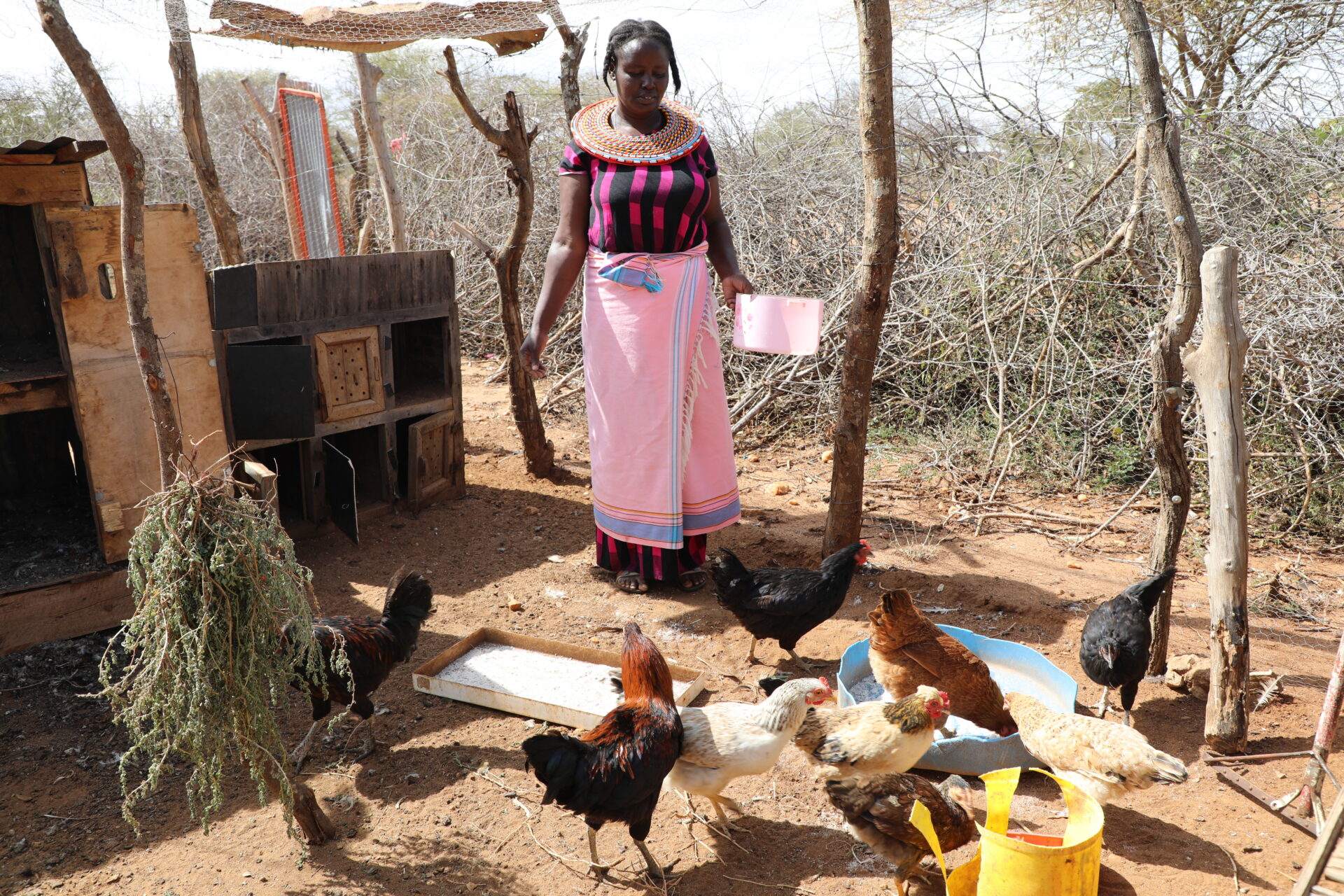
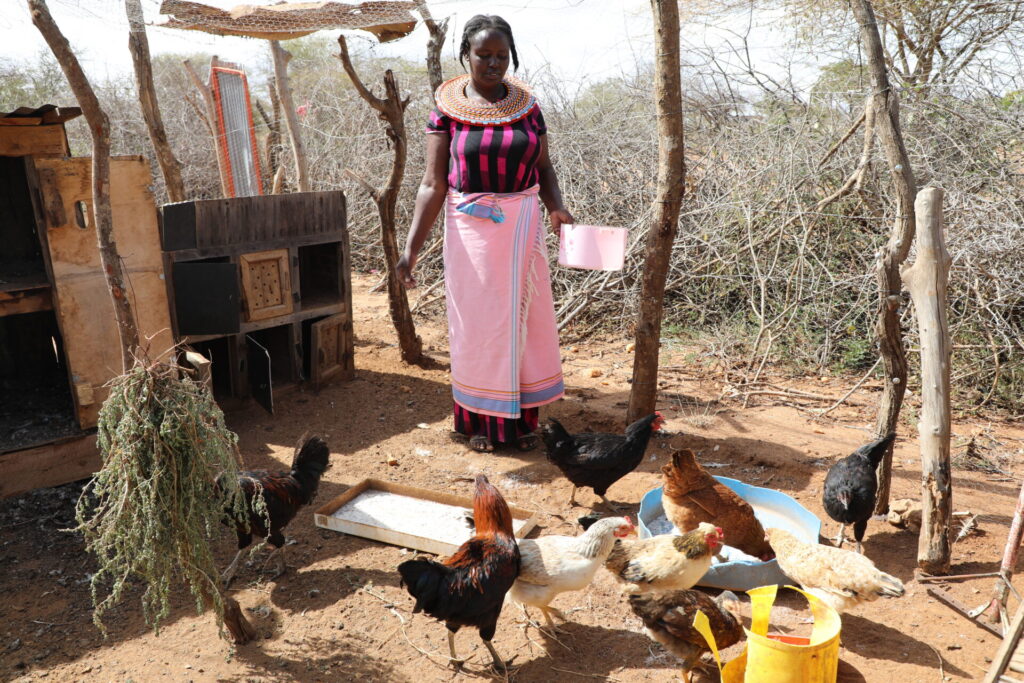
Armed with newfound knowledge, Mary erected a modern chicken house and welcomed ten improved Kienyeji chickens. The once un-valued chicken now yields a steady supply of protein-packed eggs, nourishing her family. Chicken manure, once disregarded, breathed life into a thriving kitchen garden, yielding vibrant greens and vital iron.

Mary, showing off her freshly harvested tomatoes from her kitchen garden.

Oldonyiro town became the stage for Mary’s entrepreneurial spirit. Her eggs and fresh vegetables, coveted for their quality, command a premium, fetching Ksh. 600 per sale. With her earnings, she paves the way for her children’s education and secures essential household provisions.

In Mary’s eyes, chickens are no longer mere birds but vital contributors to her family’s well-being. Her voice resounds with conviction, urging other women to embrace poultry farming, recognizing its power to fortify diets and alleviate financial burdens.

“As a Maasai, I never understood the value of chickens in our homesteads. Now, if anyone tries to dissuade me, I’d consider them my adversary. These birds have revolutionized my family’s nutrition. They’ve lightened the load of school fees for my husband and me,” Mary declares.

Poultry farming, she learned, is a beacon of stability, less vulnerable to nature’s effects compared to traditional herding. Mary Leleruk dared to step beyond convention, melding her beadwork expertise with a newfound poultry passion. In doing so, she elevated her family’s fortunes and forged a path to self-reliance.

Balancing Chalk and Coins: The Teacher-Entrepreneur’s Journey with Biashara Mashinani

Biashara Mashinani develops the capacity of men and women at the grassroots to start and manage enterprises to diversify household income and increase economic resilience.

Through the Rangelands SACCO, a community-owned and membership-driven financial organization, financial inclusion is promoted by giving members access to various tailor-made financial services, including savings accounts, affordable loans, business coaching, and investment opportunities.

Over the last six years, the Rangelands SACCO has disbursed over 200 million shillings in loans to its members. Among the 3,594 women beneficiaries is Tunu Farhiya Choya, a resident of Karare, Songa Conservancy in Marsabit County, whose life has been significantly changed.

As an employed Early Childhood Development Education (ECDE) teacher at Karare Primary School, schoolwork typically ends early, and she hardly found constructive tasks to keep her busy for the rest of the day. In 2020, the world was hit by the COVID-19 pandemic, and due to school closures, Tunu was confined to her home idle, besides house duties.

Adding to her woes was a series of salary delays that left her in a tight financial spot. As a widow with two children, this was incredibly challenging. As the months passed and her bills piled up, she realized that depending solely on her job was no longer sustainable. Frustrated by the uncertainty of when her next paycheck would arrive, she decided to take matters into her own hands, turning her free time into income.

In September, the 42-year-old rented and stocked a retail shop at the Karare market center with her savings of 15,000 shillings. The reduced competition triggered the idea, but most importantly, to offer access to necessities to the residents. Before a return to normalcy, she dedicated her full attention to her business, intending to earn extra income to care for her family. On school days, her cousin runs the store during the day, while she takes over in the afternoon after school.

In 2021, Tunu learned of the NRT Trading Biashara Mashinani program through the conservancy management. Tunu eagerly seized this opportunity and embarked on a three-day intensive entrepreneurship and financial literacy training on business planning. With unwavering determination, she incorporated the knowledge from this training into her retail business and was inspired to join Sacco to start saving. Her dedication paid off as, after disciplined savings with Rangelands SACCO, Tunu became eligible for her first loan of 25,000 shillings.

This loan came at a crucial juncture, as a prolonged drought devastated the region, leading to a dire shortage of rainfall, which greatly affected the livelihoods of the indigenous people in northern Kenya. Before the SACCO’s intervention, Tunu, like many others in her community, had grappled with a sense of hopelessness. However, she used the loan wisely, allocating funds towards her children’s school fees, investing in her business, and securing a portion for savings.
Tunu expresses her gratitude, “Being a member of the Sacco has helped me a lot despite having come from a drought season whereby I experienced highs and lows. I have used the money to stock my shop with household commodities, foods, and cereals. I look forward to receiving more loans to expand my business.”

Tunu happily serves a customer at her shop.

Today, Tunu runs her shop with a positive outlook, aiming to achieve daily profitability. On her best days, she garners up to 3,000 shillings; on others, she still manages to earn at least 500 on a bad day.

She acknowledges NRT Trading for nurturing her entrepreneurial skills and fostering her financial growth, enabling her to run a thriving business that sustains her family and contributes to the betterment of her community.

Turning Grass into Gold:  The Remarkable Journey of Grace Meitiaki from Herder to Innovator in Pasture Production

Grace Meitiaki, at 46 years of age, has walked the challenging path of a herder for many years, practicing the traditional ways of livestock keeping. This journey was marred by losses, with her livestock bearing the brunt of her outdated methods. But like a resilient sprout emerging through cracked earth, Grace’s story took a heartwarming twist.

In 2021, Grace’s fortunes began to change as she seized the opportunity to participate in the Ufugaji Bora Mashinani program supported by the USAID Local Works program, targeting 300 herders. Through this initiative, she embarked on a transformative four-module training course on better animal husbandry. The year 2023 marked a significant turning point when Grace, alongside 30 other Livestock Market Agents (LMAs), embarked on an enlightening exposure tour at the Kenya Agricultural Livestock Research Organisation (KALRO). This tour, a pivotal moment in her journey, expanded her horizons, propelling her newly acquired skills to greater heights, particularly in pasture production and management.

Grace, among other Livestock Marketing Agents (LMAs), during an exposure tour visit at KALRO Beef Research Centre, Nakuru.

Grace reflects on the eye-opening experience, stating, “The learning tour provided us with a platform to interact with experts, ask questions, and witness the practical application of the concepts we were trained on.”

With newfound knowledge and determination, Grace began a remarkable journey. She decided to invest in pasture production on her secluded piece of land, turning what was once overlooked grass into her most valuable asset. In doing so, she proved that knowledge could shatter stereotypes and barriers.

Her motivation was clear. Grace explained, “I was very keen on pasture production and management because I have been losing hundreds of livestock due to drought.” The transformation was palpable as she began producing her balanced animal blocks, enriching them with vital nutrients through animal salt, animal feeds, and molasses, all preserved under low heat.

But the story doesn’t conclude there. Grace’s training extended to module three, where she learned about conservation. Here, she discovered the potential of collecting acacia pods and preserving them, providing a lifeline to her livestock during the unforgiving drought seasons. Encouraged by the success of her initial trials, she’s preparing another piece of land to expand her pasture production. Grace also extends her heartfelt appreciation to her husband, Richard Metiaki, for his unwavering support.

In her own words, Grace emphasizes the profound impact of knowledge, stating, “Knowledge is power. I am a better herder, all thanks to Ufugaji Bora Mashinani. I am training other group members on this new venture so they can safeguard their livestock in the future.” Her joyful testimony speaks volumes about the ripple effect of education and training, creating a virtuous cycle that uplifts individuals and the entire livestock value chain.

Grace Meitiaki’s journey is a testament to the remarkable transformations that can occur when education, dedication, and support converge. Her story serves as a beacon of hope, reminding us that with the right tools and knowledge, anyone can overcome challenges and pave the way for a brighter, more sustainable future.