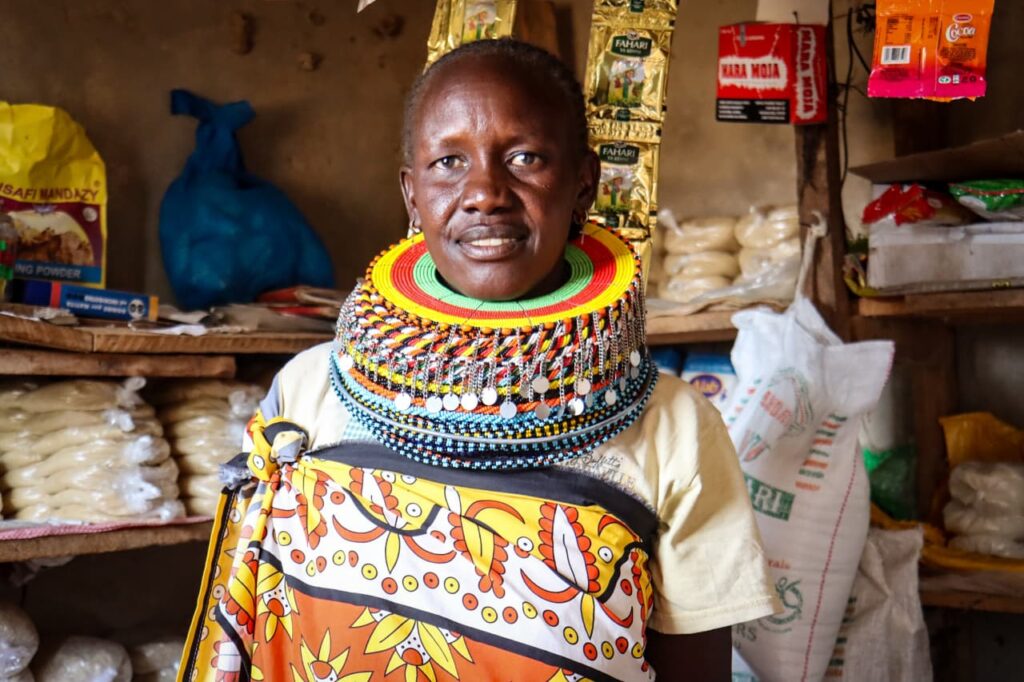
How Rangelands SACCO Microcredit is Supporting Women Entrepreneurs in the Conservancies

When Jamarose Moru thinks about her childhood, she remembers her parents struggling to keep them in school. They had never received formal education themselves, especially given their pastoralist background, which has a record of some of the lowest school-completion rates in the country, largely due to poverty and a lack of financial support. Livestock was the family’s only asset, and when schoolbooks or uniforms were needed, a goat or sheep would often be sold. Her eldest sister reached Class Eight before dropping out; the two subsequent siblings never enrolled. Jamarose managed to finish primary school, but the cost of secondary education was far beyond what her family could afford.

After leaving school, Jamarose found herself on a path that many young women in her situation often tread. She rose early to fetch water, sometimes firewood, helping her mother with chores, and tended to the family’s herd until she got married by the time she was 18. Her husband’s income as a casual security guard was irregular, and with children to care for, Jamarose turned to selling charcoal, a demanding, environmentally taxing trade, but the only option available at the time.

In the middle of her day-to-day activities, she would often pass a group of women who met regularly under a tree, with a locked metal box at the centre of their circle. In a place where little went unnoticed, everyone knew what the gatherings were about: the local Village Savings and Loans Association (VSLA). Jamarose had always known of it but never thought it could apply to her; saving a few coins seemed pointless when every shilling already had a purpose. Yet she couldn’t ignore how the group seemed to weather difficulties differently by finding help among themselves. That quiet sense of security and the way they supported one another began to shift her thinking. After a while, she joined them, considering it a small but hopeful beginning.
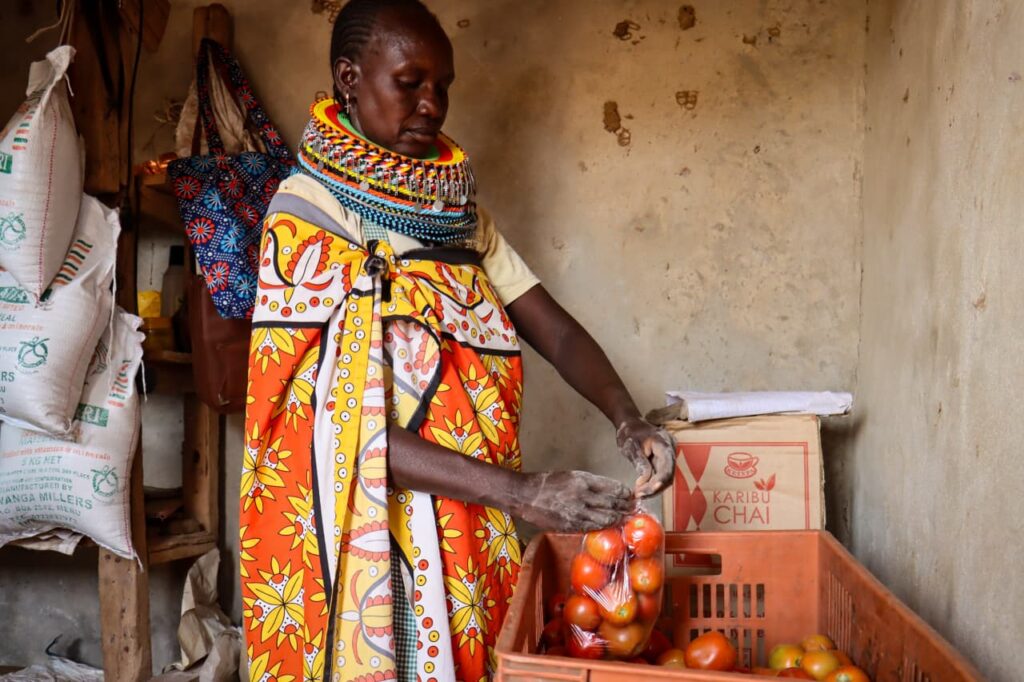
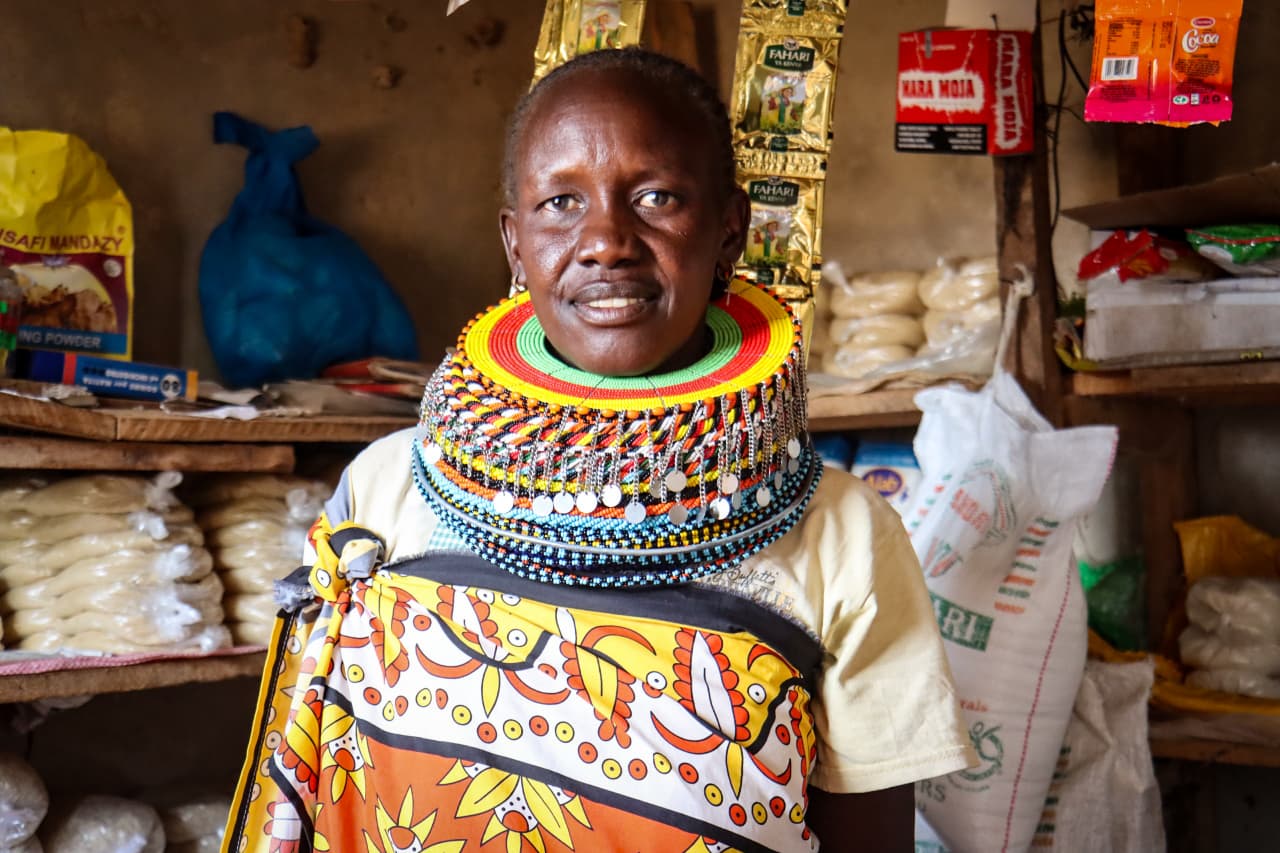
Jamarose packs tomatoes for a customer

In January 2018, she was also introduced to Rangelands SACCO through its Community Enterprise Agent. As a member of a formal financial institution, she saw it as an opportunity to strengthen her growing financial discipline and began saving consistently. By 2023, her savings were enough to qualify her for a first loan of Ksh. 60,000. With that, she opened a small shop near their manyatta in Attan, just about a kilometre from Tractor, the nearby town centre within the Nakuprat-Gotu Conservancy. Her shop became a direct response to the everyday challenges her community faced. Many residents had to travel long distances to Isiolo town to buy basic supplies, making the trip inconvenient and costly. By stocking essential goods such as sugar, cooking oil, rice, cereals, and even stationery, she met local demand and eased the financial and physical burdens of access.

That same year, a Biashara Mashinani endline survey found that 99.7% of businesses supported in NRT community conservancies had survived the 2022–2023 drought. Among them was Jamarose’s, which, despite enduring significant losses, remained operational. Her customers, mostly livestock keepers, were struck, forcing them to migrate in search of pasture and water. Much of her income was also channelled towards ensuring the survival of their animals, including veterinary services, supplements, and water. In 2024, determined to recover and strengthen her business, she secured a second loan of Ksh. 70,000 from the Sacco, which she used to renovate and expand her shop, ensuring it could better serve her customers’ needs.

On good days, she can serve up to 30 customers, bringing in around Ksh. 5,000. However, there are also slower days when her earnings might only reach Ksh. 1,000. When the business is less busy in the afternoon, she tends to their one-acre maize and bean farm and sells the surplus in her shop for extra income.
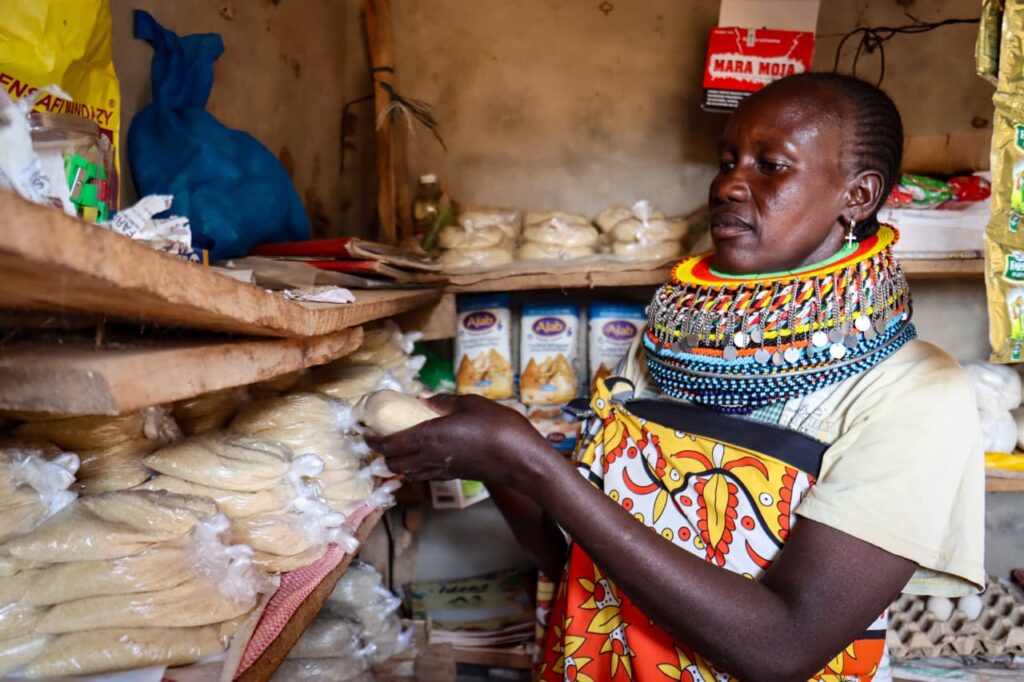
Jamarose arranges packets of sugar neatly on the shelf

The mother of seven has long-term plans to take her business to the next level. One of her big goals is to enrol in a driving school so she can obtain her license and eventually secure another loan to buy a vehicle to help her deliver goods more efficiently. With reliable transportation, she hopes to reduce delivery costs and grow her business into a supply hub for other local shopkeepers.

Jamarose has become an advocate for sustainable, climate-conscious entrepreneurship, encouraging other women to explore alternatives to charcoal-burning and to join financial institutions such as Rangelands SACCO. She believes that access to tailored services, including savings, credit, investment opportunities, and valuable training in entrepreneurship and financial literacy, can transform lives, and she’s determined to help others tap into that potential.

Ujuzi Manyattani and the Making of a New Generation of Entrepreneurs

It is a Wednesday morning in Archers Post, and by nine o’clock the town is already alive with activity. Just off the highway, a freshly painted pink door stands out among a row of stalls. Through the string curtain at its entrance, black-and-pink salon chairs are visible beneath warm gypsum lights reflected in wide mirrors. A customer, freshly shaved, leans forward to inspect his reflection. At the counter, a woman jots in a notebook, shelves of neatly arranged beauty products framing the space.

That woman is Priscilla Nchichi Juma, a 36-year-old entrepreneur and the owner of Vinpelo Spa & Salon. When Priscilla first expressed interest in studying hairdressing and beauty therapy, reactions were mixed. Some encouraged her; others dismissed it as impractical, a pastime rather than a profession. Today, her confidence is unmistakable, rooted in the experience of building a business from the ground up.

Before all of this took shape, Priscilla’s life was far from what it is today. The youngest of seven children, life changed drastically after losing both parents and the family’s circumstances shifted abruptly. Priscilla and her siblings were taken in by relatives, and her maternal aunt became her guardian, doing her best despite limited means. Although Priscilla completed primary school, financial constraints made secondary education unattainable.

In the years that followed, she relied on casual work to contribute to household needs. The income was modest and unpredictable, leaving little opportunity to save. At 22, she married and continued working to support her family. Together with her husband, they managed as best they could, but school fees, food, and daily expenses consumed most of their income, leaving little room to invest in a business of her own.

Her introduction to hairdressing came through informal work at local salons. She began with basic tasks like washing clients’ hair, cleaning up, and handing over hairpieces to stylists in the middle of braiding. Before long, she was helping with cornrows, blow-dries, and styling. “Watching clients light up when they looked in the mirror made me fall in love with this work,” she recalls.

Priscilla performs a facial scrub for a client

Although she dreamed of owning a salon, Priscilla believed that proper training was essential – more than just skills learned by observation. She held onto her dream, considering it something for “one day.” That opportunity came in 2024, when she learned about Ujuzi Manyattani, a flagship mobile vocational training program under MashinaniWORKS that aimed to empower youth and women like her through practical skills training, without disrupting their way of life. The program, endorsed by the Sera Conservancy management, local leaders, and stakeholders, arrived at the right moment for her. Priscilla enrolled in a three-month course in hairdressing and beauty therapy and the program’s flexibility allowed her to attend classes while caring for her youngest child, making learning seamless for mothers like her.

Under the guidance of an instructor from Kiirua Technical Training Institute, Priscilla strengthened her technical skills, learning braiding, haircutting, skincare treatments, manicures, pedicures, and makeup application. Alongside vocational skills training, she and her classmates received business and financial literacy training, which is a key component to developing the skills needed to manage sustainable enterprises and generate profitable income. It has played an essential role in enhancing graduates’ business acumen, leading 88% of them to establish promising careers in related fields.

Priscilla completed the three-month training in June 2024, earning a Level 3 (Mastery) certificate in Hairdressing from Nyeri National Polytechnic, a nationally recognised qualification. She also received a startup toolkit to help her begin her journey in the beauty industry. Rather than opening a salon immediately, she took time to plan carefully. She began by working from home and offering mobile services within her neighbourhood, refining her skills while saving and learning about local demand.

Priscilla receives her certificate and start-up toolkits in the presence of dignitaries, led by Former British High Commissioner to Kenya, Neil Wigan, during the Ujuzi Manyattani graduation held in Doldol on 19th June 2024

As a member of a women’s table banking group, Priscilla had been saving and borrowing from their shared fund. When the time felt right, she combined her savings with a small loan. The funds allowed her to renovate a space, purchase salon furniture, and stock essential products. A few months later, her long-held dream became Vinpelo Spa & Salon.

The response from the community exceeded her expectations. Men came in for haircuts, while women booked appointments for styling and beauty services. Products that were previously difficult to find locally sold quickly. Saturdays, which coincide with market days in Archers Post, became especially busy, bustling from morning until afternoon. Today, the salon generates between KES 8,000 and 10,000 on a good day from services and product sales.

Competition in the beauty industry is unavoidable, especially in her industry, where loyalty runs deep. However, her clients keep returning. She attributes this to offering personalized attention, consistent follow-ups, and treating everyone as if they were the first of the day. This professionalism has earned her trust and word-of-mouth referrals which have slowly become her strongest marketing tools.

Her success now extends beyond her own household. The salon employs two young people, one as a barber and another assisting with hair and beauty services. The income she earns has also enabled her to support three teenagers in school, some of whom are orphans or come from financially vulnerable families.

Looking ahead, Priscilla plans to expand into wholesale beauty supplies and eventually become a Trainer of Trainers, which will offer a practical way to sharing skills to extend opportunity to other young people build livelihoods of their own, drawing directly on the pathway she accessed through Ujuzi Manyattani.

Leadership in Business and Conservation – The Story of Pauline Lolngojine

Recently, women in northern Kenya have emerged as key decision-makers in their communities. They now hold leadership positions and have gained control over benefits, which has resulted in their full participation in the economy as market actors.

Pauline Nduraa Lolngojine is a 47-year-old mother of five from Archers Post in Samburu County, whose story embodies resilience, community impact, and empowerment. Married off at a young age, her education was abruptly cut short in Form 3. However, Pauline chose not to despair. Undeterred by the following hardships, she seized an opportunity during the construction of the Isiolo-Moyale highway to start preparing and hawking meals for the workers. This marked the beginning of her entrepreneurial venture, and she soon expanded to selling groceries by the roadside.

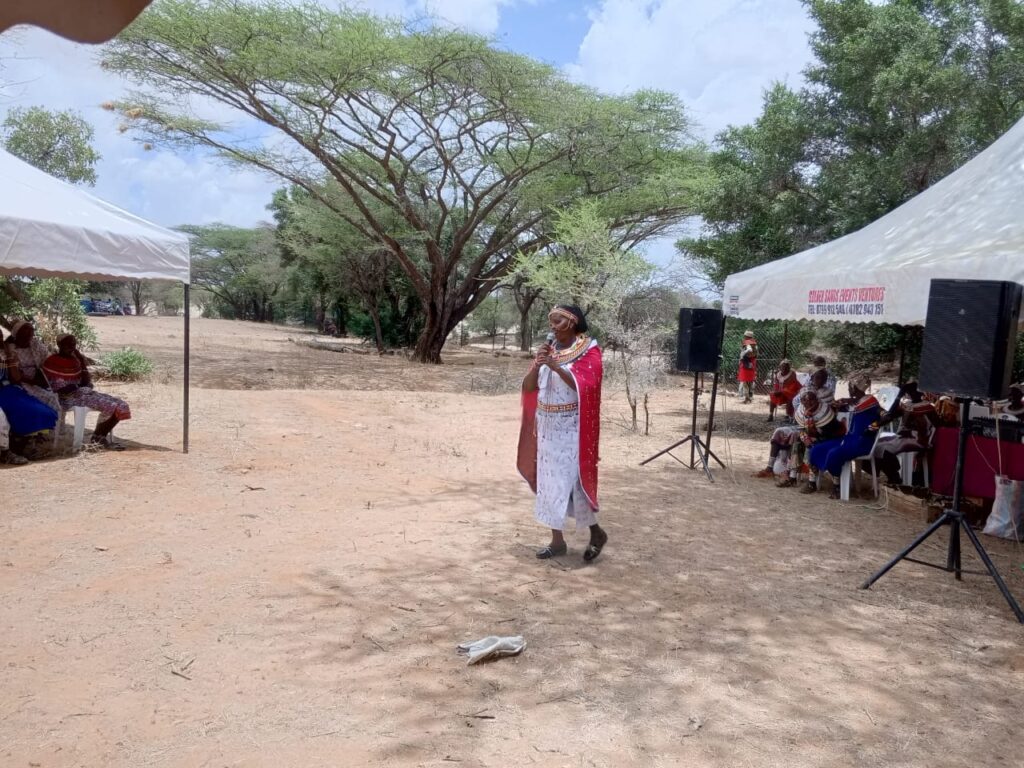
Pauline addresses women during the Marsabit women’s caucus.

As a member of the Sera Community Conservancy, Pauline’s conservation efforts earned her a position on the board, where she later became the tourism chairperson, breaking barriers as the only female in this role. Her journey continued as she was re-elected as the Conservancy’s Chairperson, solidifying her position as a powerful voice for women.

In 2018, Pauline joined Rangelands Savings and Credit Cooperative (Rangelands SACCO), an independent, community-owned, and membership-driven financial organization. Elected as the chairperson, she embraced the training and guidance provided by the SACCO to become a star entrepreneur. Through Rangelands SACCO, Pauline received loans that she strategically invested to catalyze the growth of her businesses. The entrepreneurial and financial literacy training, including business planning, customer service, marketing and branding, managing profits and losses, costing, and pricing, equipped her with the skills to manage every aspect of her enterprises.

Being among over 6,000 members, the impact of Rangelands SACCO on Pauline’s life is evident from an initial loan of KES 30,000 to her latest loan of KES 900,000. She secured her children’s education and a plot for her restaurant and invested in equipment and materials, elevating the quality of her services. The loans met her progressive targets and positioned her in a better place.

Pauline provides outside catering services at Uaso Girls to children on an educational trip.

Her entrepreneurial journey saw her venture into diverse fields, from groceries by the roadside to outside catering services and a Choma Zone (roast meat) restaurant that will serve travelers along Archers Post.

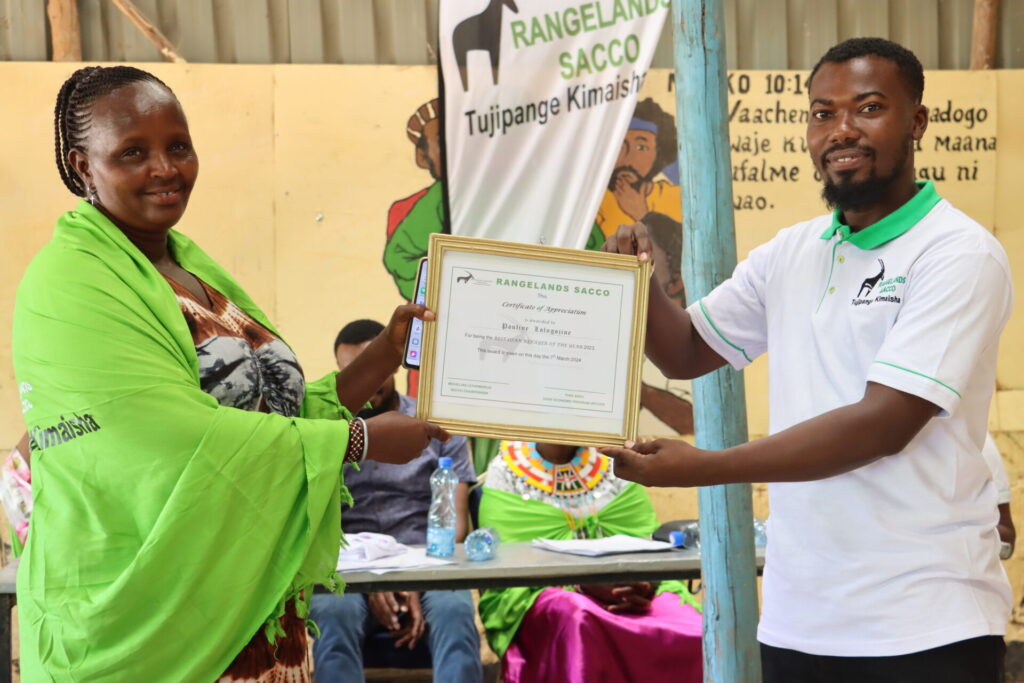
In the Annual Delegates Meetings held on 26th April 2023 and 7th March 2024, she was celebrated as the best borrower in 2022 and 2023, respectively. “The awards motivate me to keep achieving my goals in the Sacco and being a role model by uplifting others through giving them advice and showing them my best practices,” says Pauline. Her journey with Rangelands SACCO is not just about financial gains; it’s about inspiring and uplifting an entire community, creating a ripple effect of positive change. Pauline has become an employer, creating job opportunities and contributing to the economic growth of her community.

Pauline receives her certificate as the Best Borrower in 2023 during the Rangelands SACCO Annual Delegates Meeting held on 7th March 2024
Pauline receives her certificate as the Best Borrower in 2022 during the Rangelands SACCO Annual Delegates Meeting held on 26th April 2023

As Pauline envisions securing plots for accommodation facilities and campsites, her dreams extend beyond personal success. She aims to contribute to the growth of the local economy and leave an indelible mark on the community that she holds dear.

From Shadows of Crime to Illuminating Life Skills: Evans Echwa’s Journey From Banditry to Entrepreneurship

A large, healthy livestock herd is a pastoralist’s pride and joy.

For indigenous pastoralist communities, it is the main currency, the only one that truly matters, culturally speaking. In the vast expanse of Nakuprat Gotu Conservancy, a young moran named Evans Echwa toiled in the fields, herding his family’s livestock for years. His journey, however, was far from the ordinary.

Echwa, a 26-year-old with a weathered spirit, dropped out of school at the tender age of class five, burdened by the responsibility of caring for his family’s cattle. Little did he know that his challenges would be as relentless as the scorching sun that beat down upon the arid land in northern Kenya.

Drought and banditry attacks became haunting shadows, casting uncertainty over his family’s livelihood. Preserving the cattle family’s only source of livelihood became critical. As pasture and water supplies dwindled, Echwa moved the herd further from home in search of grazing fields. Sometimes, he would cover distances of up to 100 kilometers to ensure the cattle were adequately fed and watered.

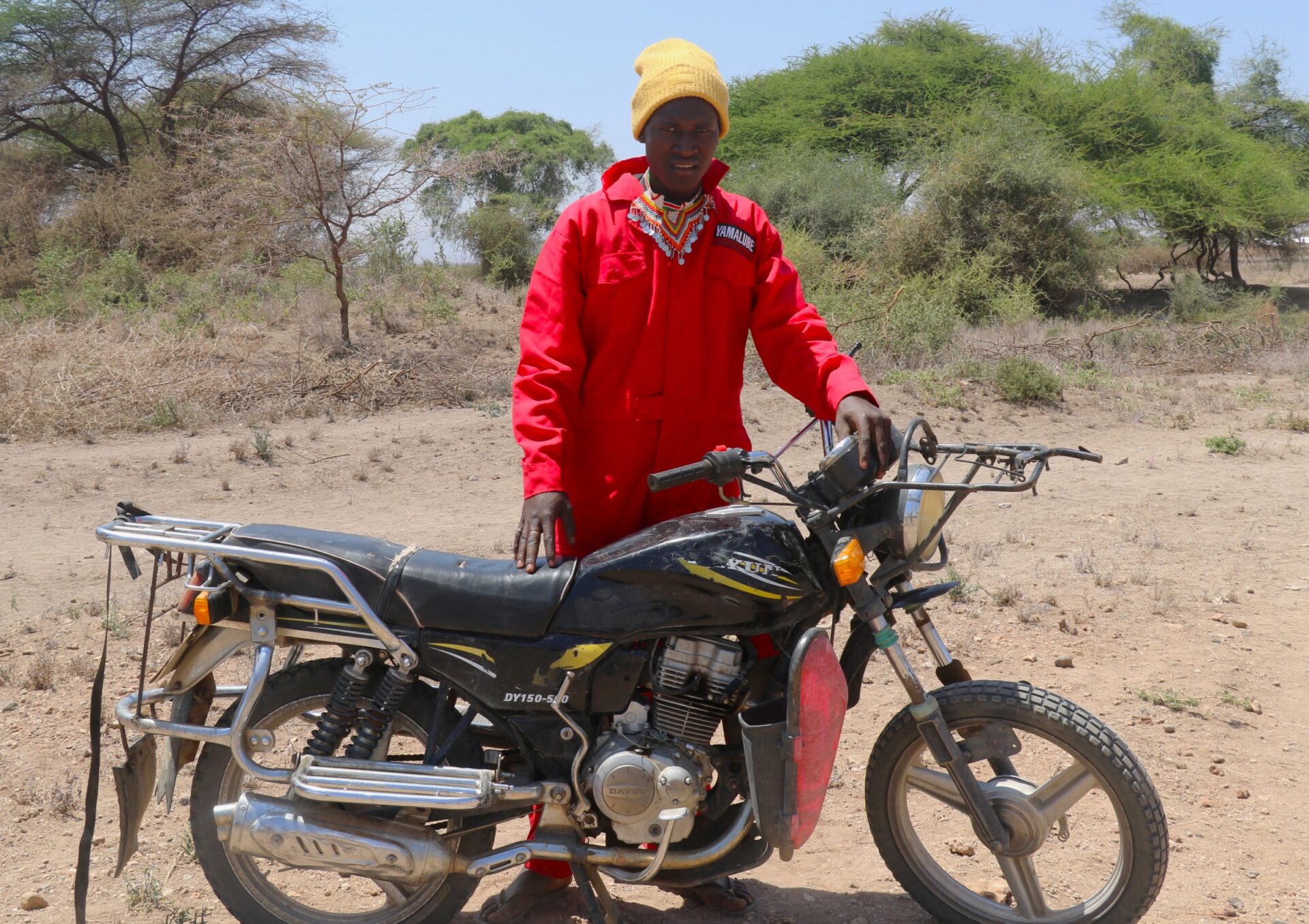
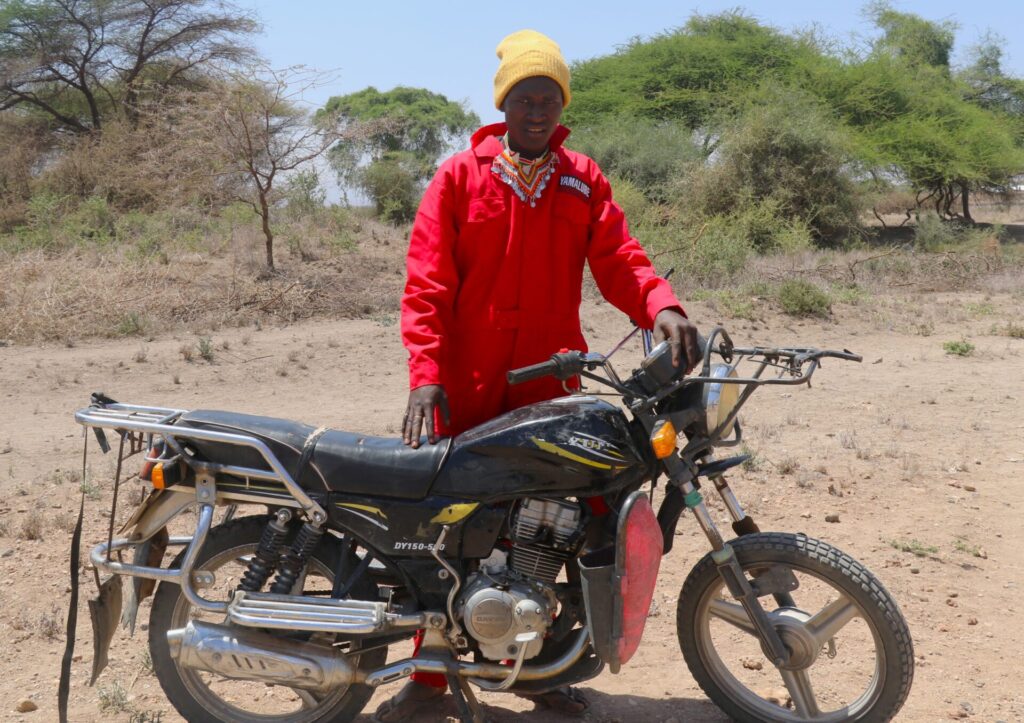
Echwa at his garage in Kiwanja, Nakuprat-Gotu Conservancy

A life without the livestock was unimaginable!

As northern Kenya endured its fifth consecutive failed rainy season, Echwa’s greatest fear became a reality when the prolonged drought eventually wiped out his family’s entire herd. Left with no alternative source of income and being a lower primary school dropout, Echwa and his family faced a grim future. 

Faced with shame and the weight of family blame, he embarked on a daring journey to recover what was lost. In a desperate bid for retribution, Echwa joined fellow morans and raided the neighboring community for livestock.

The fateful raid unfolded with a tragic climax -Echwa was shot alongside his fellow morans, and some of his comrades paid the ultimate price. The merciless bullets sprayed upon them did not spare his comrades’ lives.

His Turning Point!

Lucky to survive, Echwa nursed back to health in the sterile walls of a hospital, where he found himself at a crossroads. With the ghosts of the past crimes haunting him and the loss of his comrades weighing heavy on his conscience, he contemplated a new path for his life. One that diverged from the shadows of violence and into the realm of a better life.

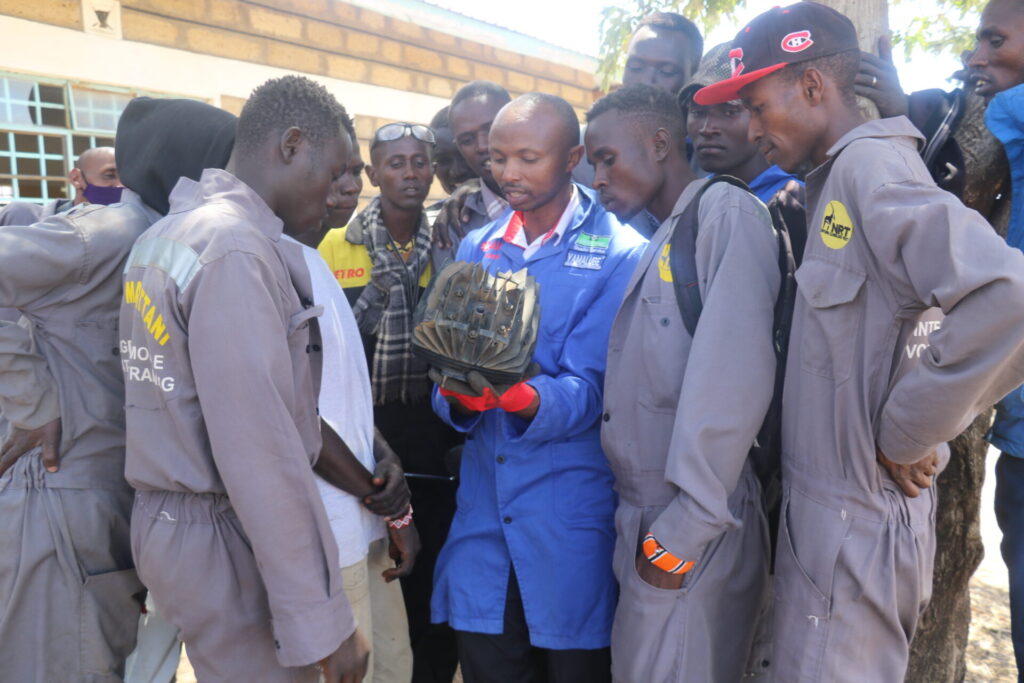
Echwa and his fellow Ujuzi Manyattani trainees during a two-day Yamaha motorcycle training in 2022 courtesy of Toyota Kenya

Determined to rewrite his narrative, Echwa faced the uphill battle alone, without support for his newfound ambition. However, fate intervened during one of his idle days. In 2021, he discovered that NRT Trading Ujuzi Manyattani was organizing a sensitization meeting at Nakuprat Community Conservancy. The vocational programs offered by the organization offered a beacon of hope for people like him who were looking for an opportunity to better their lives through marketable skills.”

Undeterred by his lack of formal schooling, he applied, half-expecting rejection. To his surprise, the opportunity embraced him. “I applied for a course in motorcycle repair, and I was surprised to qualify even at my level,” recounts Echwa with a spark of gratitude in his eyes.

The next three months became a transformative journey as Evans immersed himself in the Ujuzi Manyattani vocational training program that places trainers in the villages. In April 2022, he emerged not just as a graduate but as a symbol of resilience, armed with startup tool kits and a newfound sense of purpose.

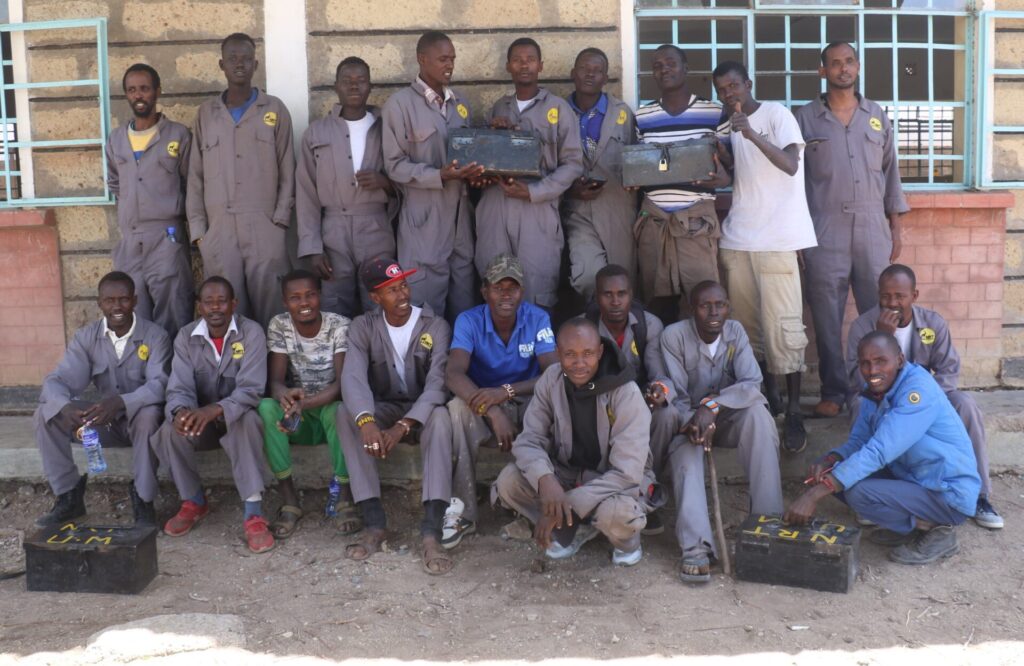
Echwa and his fellow trainees pose for a photo

Echwa established his garage in the heart of Kiwanja village, located in Isiolo County, within Nakuprat Gotu Conservancy. He sees his enterprise as a business and a force for positive change. “Running my own garage has given me a lot of focus in life. I am no longer dependent on banditry crimes to survive. My mind is now focused on how to expand my business and be of more help to my community and family,” he says.

Evans Echwa, once a herder bound by the trials of the land into banditry, is among the 88% of Ujuzi Manyattani graduates who have embarked on self-employment through setting up their businesses, hence earning an income to secure their livelihoods.